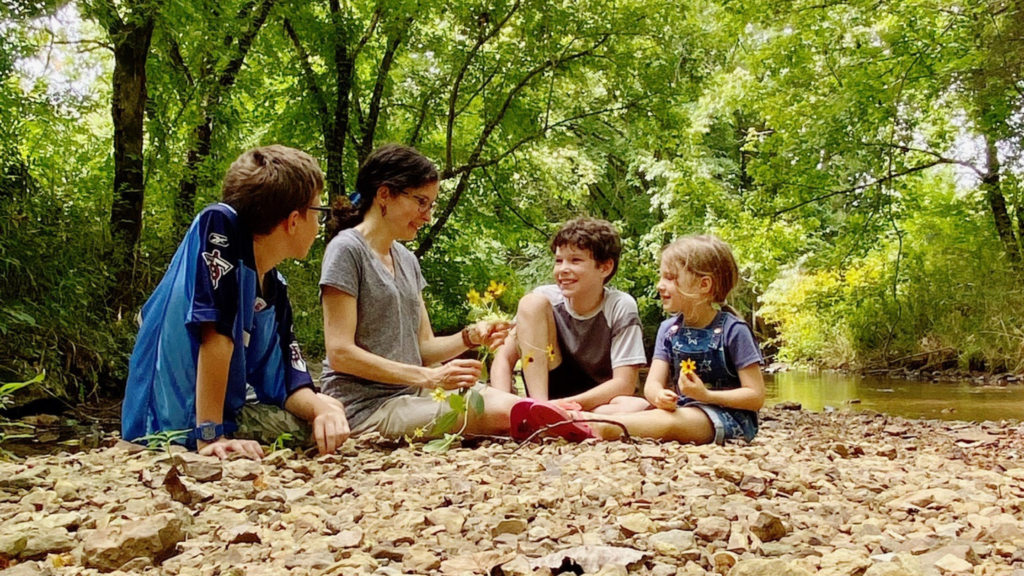
One of my favorite ways to introduce science to my children is through nature walks. Nature walks allow for hands-on learning, observation, and conversation. Not only that, it allows my children to appreciate and have a love for their natural surroundings.
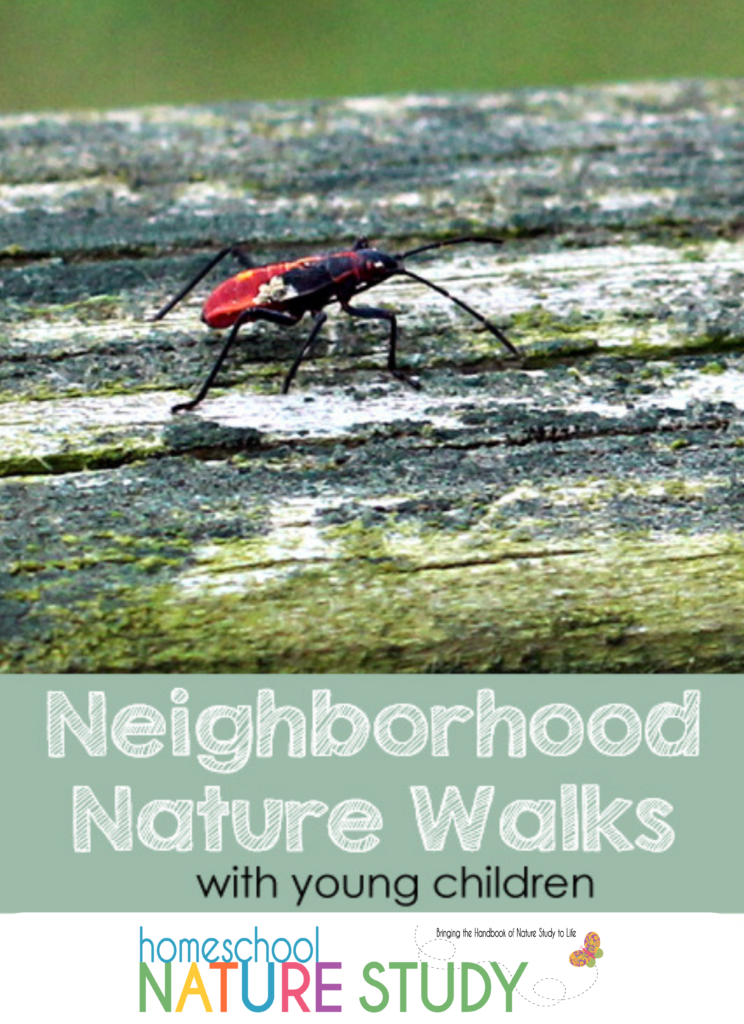
Neighborhood Nature Walks With Young Children
Nature walks do not need to be complicated. As a mom with four young children, I need to be close to home. In order for my family to plan nature walks in our week, it has to be easy or it just won’t happen. Many times all my family does is step outside! Our own neighborhood has its own natural treasures to find.
Nature Study And Toddlers
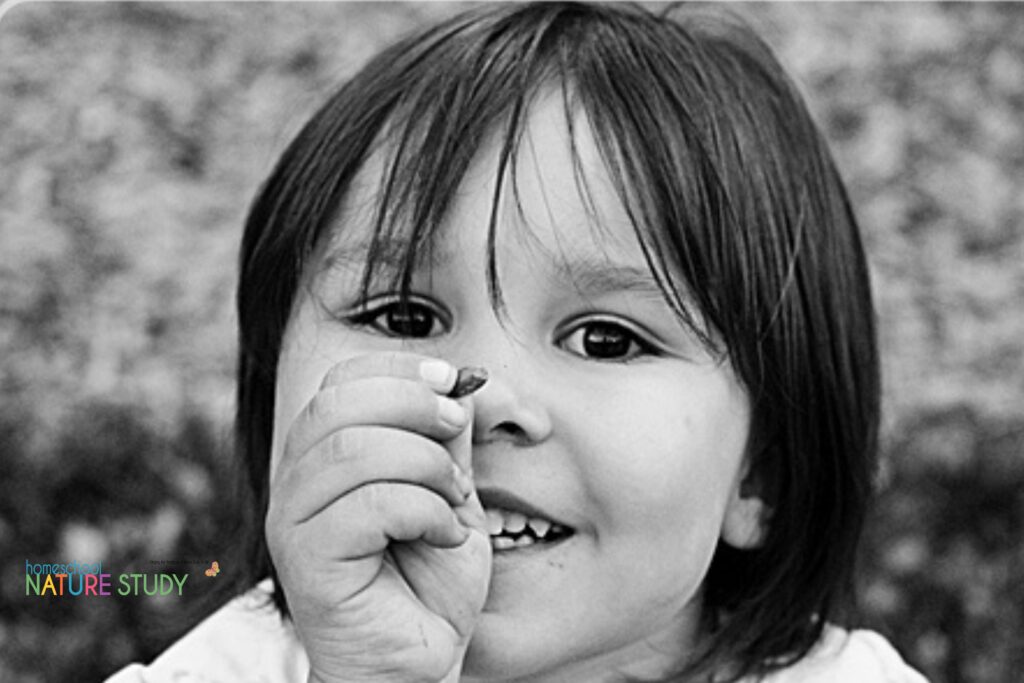
One very windy day, a small evergreen tree caught the attention of my 1yr. old. It was swaying in the wind, almost inviting her to come over and inspect it. She stood there for awhile, just touching the pine needles and smiling. Nature observation happened right in our own backyard (Of course not everything in nature can be touched! Watch small children closely.)
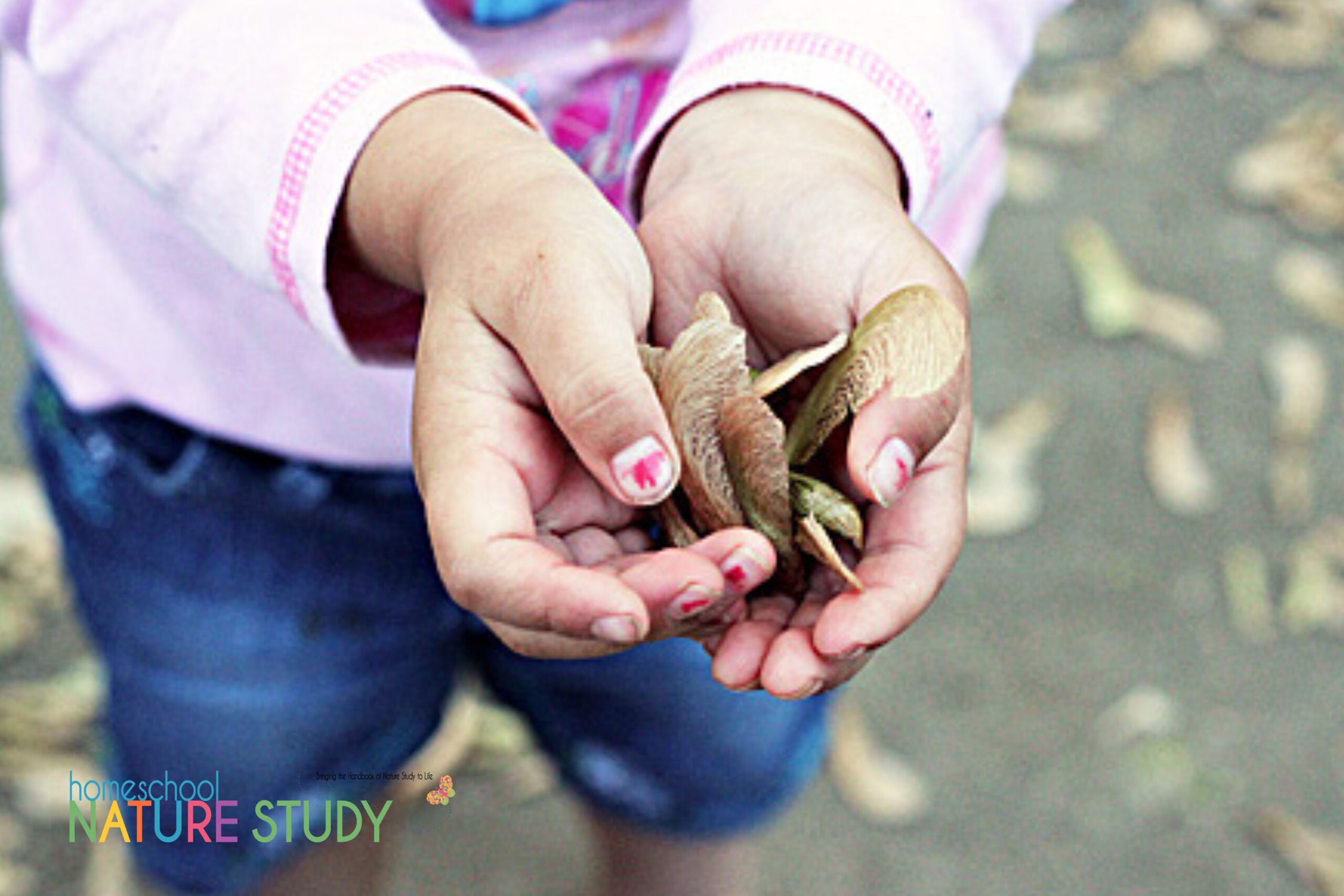
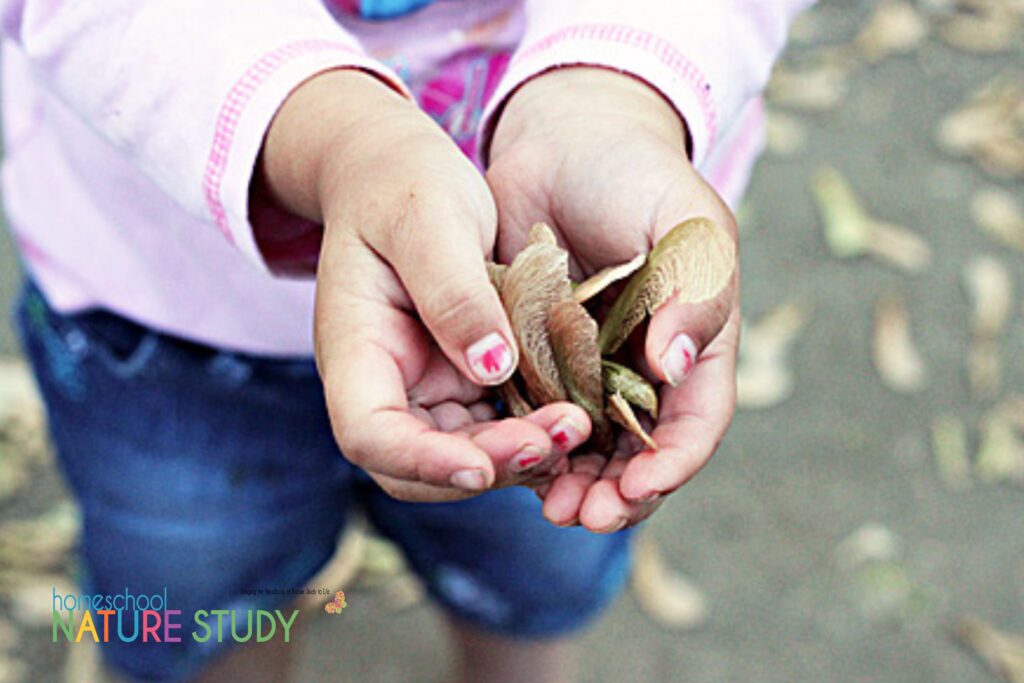
In our area, maple seeds blanket the area in the fall. Since these seeds are everywhere we look, I had my daughter grab a handful so that we could observe them. What were these things? Why do you think they have the long “tail”? What happens when we throw one up in the air?
Then we removed the covering to find the seed. What color is the seed? What do you think will grow from this seed? What does a seed need in order to grow? These were some of the questions that were asked as we observed maple seeds right in our own backyard.
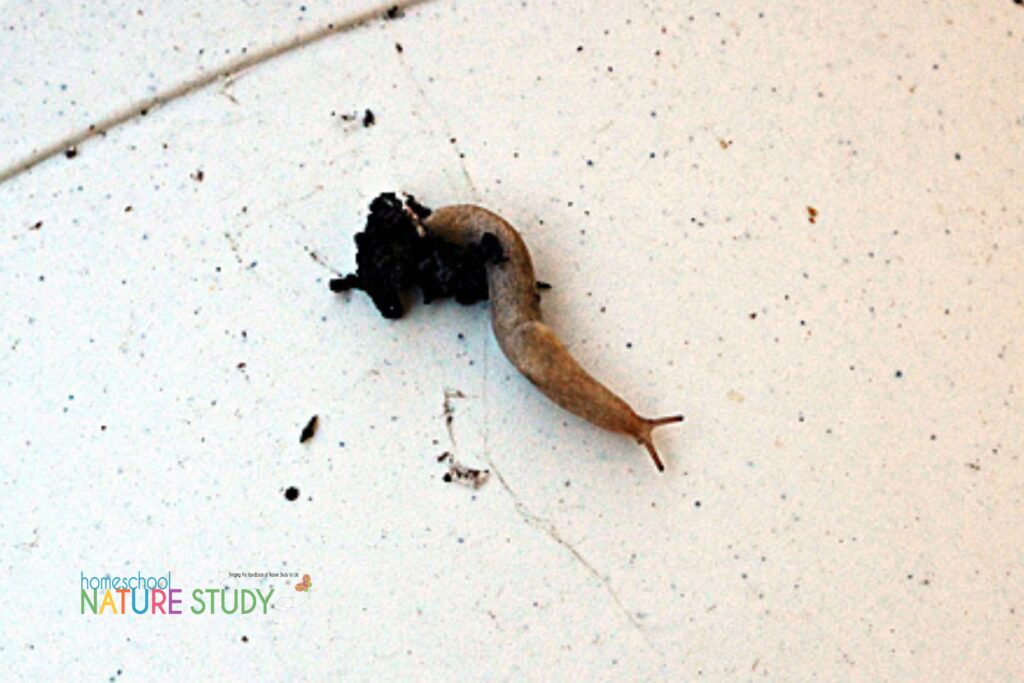
When we were cleaning up our backyard, I lifted a flower pot and found a slug. I called my 3-year old over to see. What is this? Which end is the head? What are those two pointy-things at the top? (optic tentacles) What do you think they are used for?
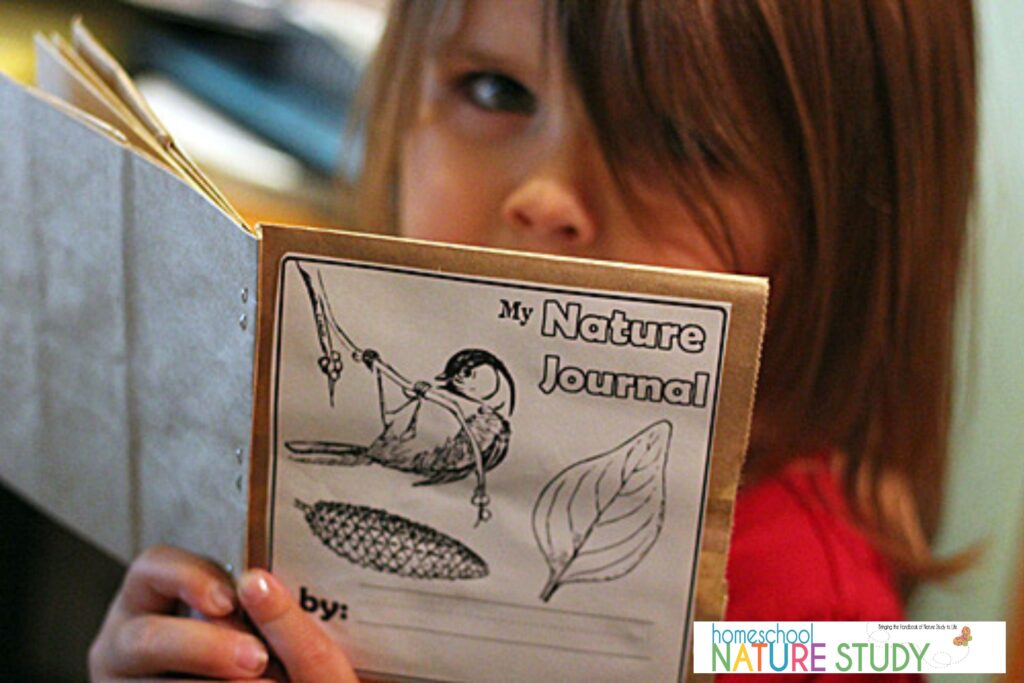
My daughters have their own paper bag nature journal. The inside pages have a place where they can draw what they have observed on their walk. They can also glue nature items, or collect items and place them in the bag. There are so many ways to use paper bag books and they are the perfect size for preschoolers.
Sometimes though, I need to step away and just let my children enjoy nature on their own without the purposeful direction and questions. When I do this, I find they usually come up with questions on their own that we talk about and take time to study later.
Enjoy ALL of our preschool nature studies plus access to the Outdoor Hour Challenges curriculum for the whole family in Homeschool Nature Study Membership.
By Maureen Spell, a long-time contributor to the Outdoor Hour Challenges.Maureen helps Christian mompreneurs operate their business from a place of joy, purpose, and excellence because they are clear on how their business is serving their family and others. As a homeschool mom, she believes success at home AND business without the mom-guilt, stress and burn-out is possible! Outside of work, she loves having good conversations over a hot chai or GT Gingerberry kombucha and spending time with her husband and seven children. Visit her at MaureenSpell.com
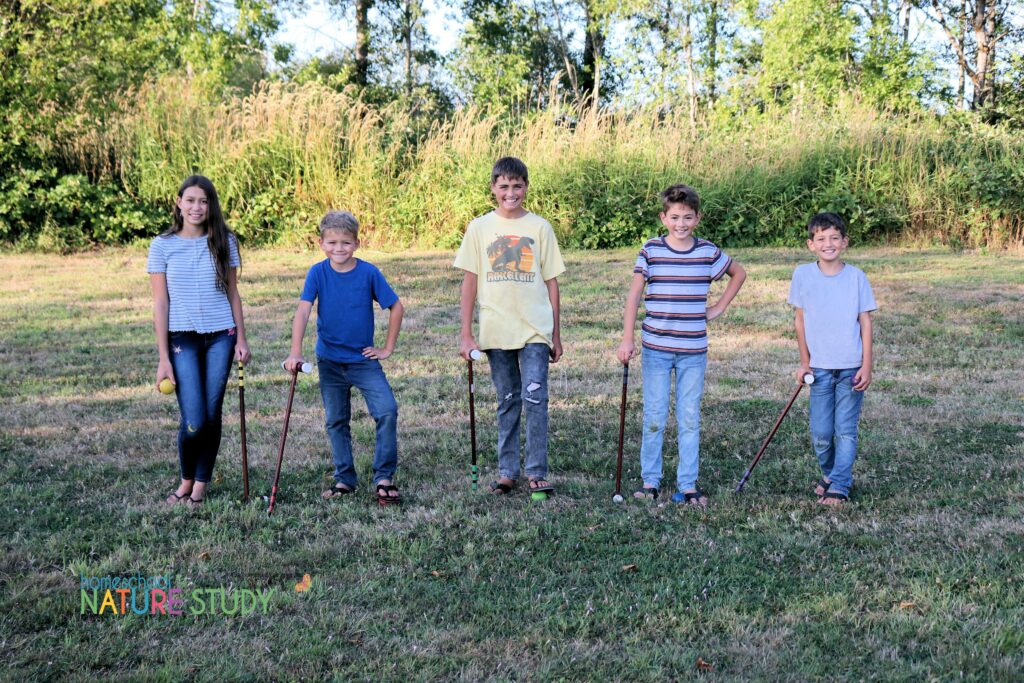
Imagine making unforgettable memories with your children through outdoor play. Laughter, smiles, and a time of connecting as a family are only a few virtues of simply getting outside. Immersing ourselves outdoors with our children also cultivates relationships, encourages bonding, and nurtures our mental health. These 5 outdoor games are the very best to encourage a love of the outdoors and have fun!
The Importance Of Outdoor Play
“Years of research have revealed how vital being out in nature is to our mental health: from listening to water trickle, smelling the forest air, or staring at fractals and cobwebs, it all counts as healing, soul-stirring endeavor that we’d do well to invest time in as much as we can. All children benefit from being outside whether homeschooled or otherwise.”
In her book, Modern Miss Mason, Ms. Boden asserts,
“When we step outdoors, we find the seeds of science, biology, physics, history, mathematics, and more.”
Ms. Boden (p. 107)
In a recent outdoor time of exploring the beaches, my toddler was captivated by all the ladybugs congregating on an old log. He observed with interest and admired the ladybug’s arrangement: from her little legs, her coloring, and her black dots. My smitten toddler added four new words to his vocabulary, “babybug” (ladybug), “bots” (dots), “bwack” (black), and “wed” (red). We added a bit of mathematics as he counted Ms. Babybug’s legs and her little black dots. This time outside encouraged bonding, self-education, communication skills, and unfolded multiple subjects in a natural way.
When we create time to step into nature, a realm of gentle learning happens that is beneficial to a child’s development:
patience
teamwork
observation skills
fine and gross motor skills
and so much more!
So, how do we reap the all the benefits of outdoor time? And how do we involve our children outside more? Let’s take a look at a few ways we can facilitate this special time in nature with our loved ones.
The 5 Best Outdoor Games For Kids
Are you interested in spending valuable time outdoors with your children? Do you desire to hear a lot of giggles, build gross and fine motor skills, shape social skills, practice teamwork, and foster family connections? Try the five best outdoor games for kids. We have included games that are perfect for all ages. Beware! When you’re all done, you may hear your children eagerly exclaiming, “Mom, let’s play that again!”
Sack Races
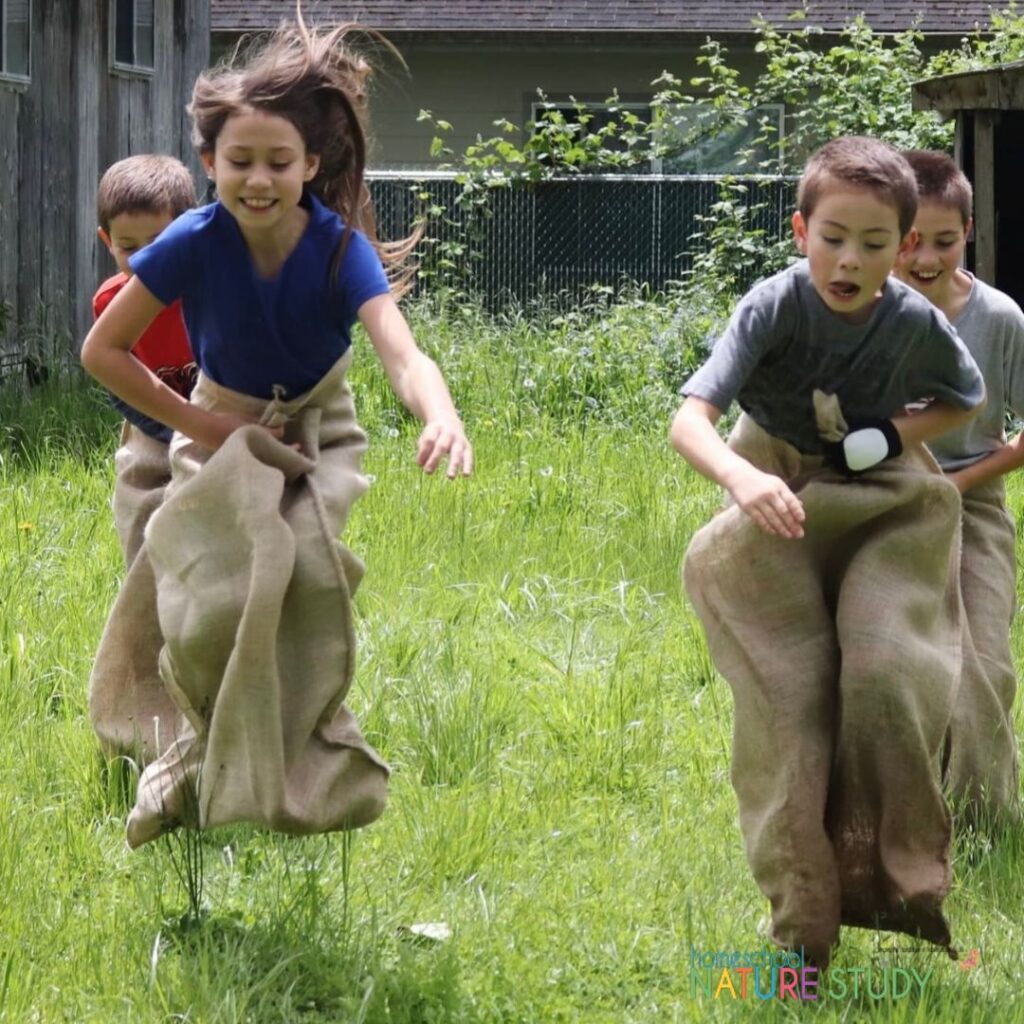
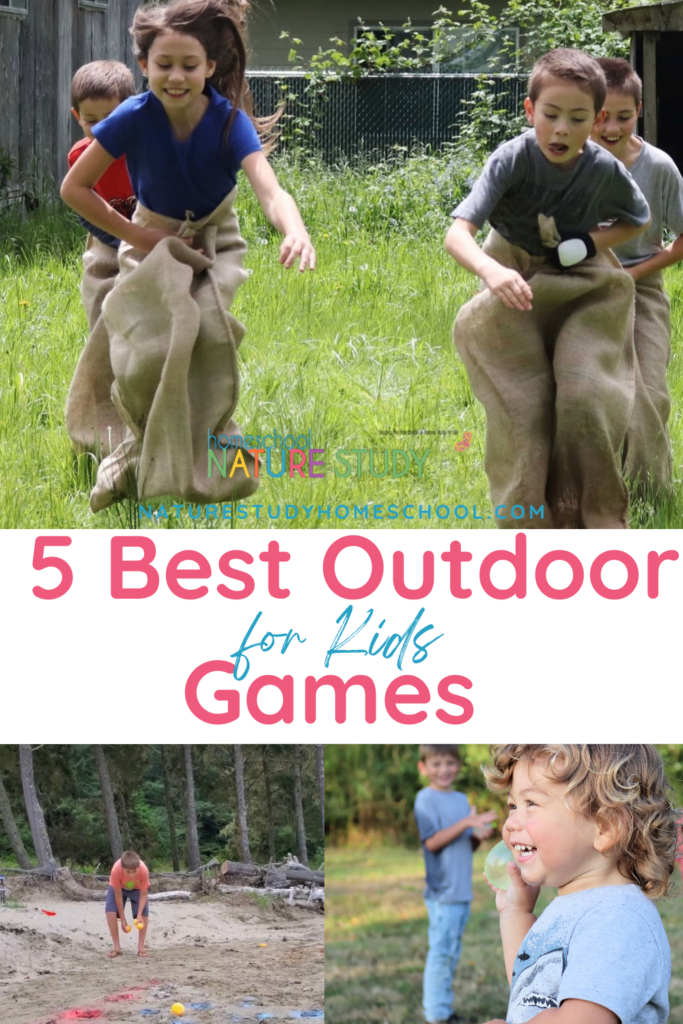
This game is extremely easy and fun. Sack races also help with getting those wriggles out. Start your players with boundaries by creating a “start” line and a “finish” line. Each player places both feet in a sac or pillow. When they hear a “START!” or “GO!”, all players hop to the finish line. The first one to the finish line wins!
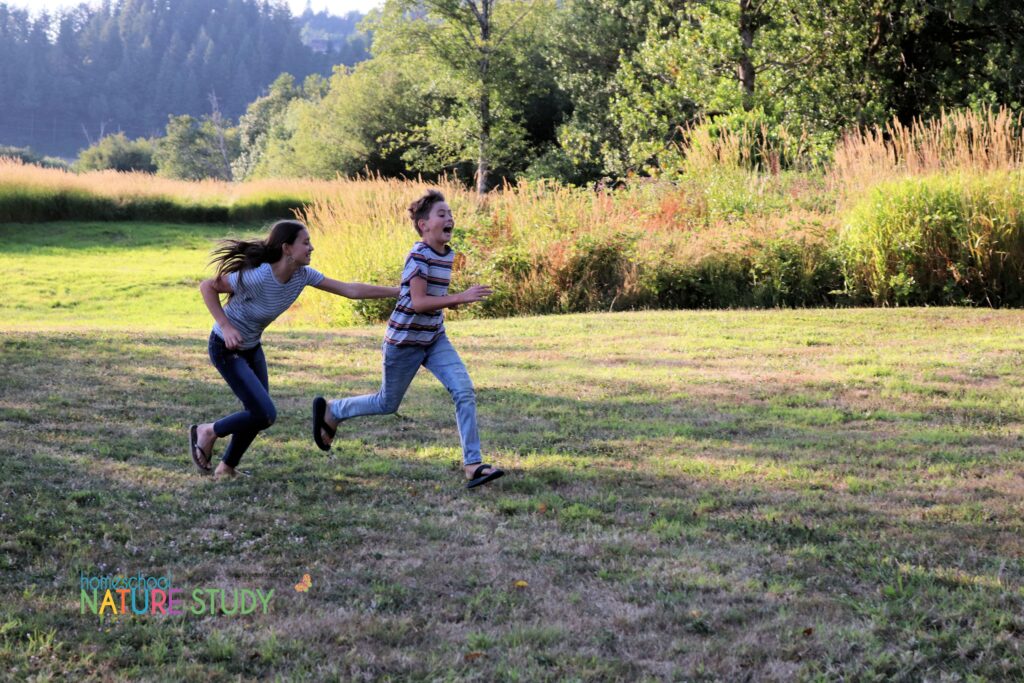
Sharks and Minnows
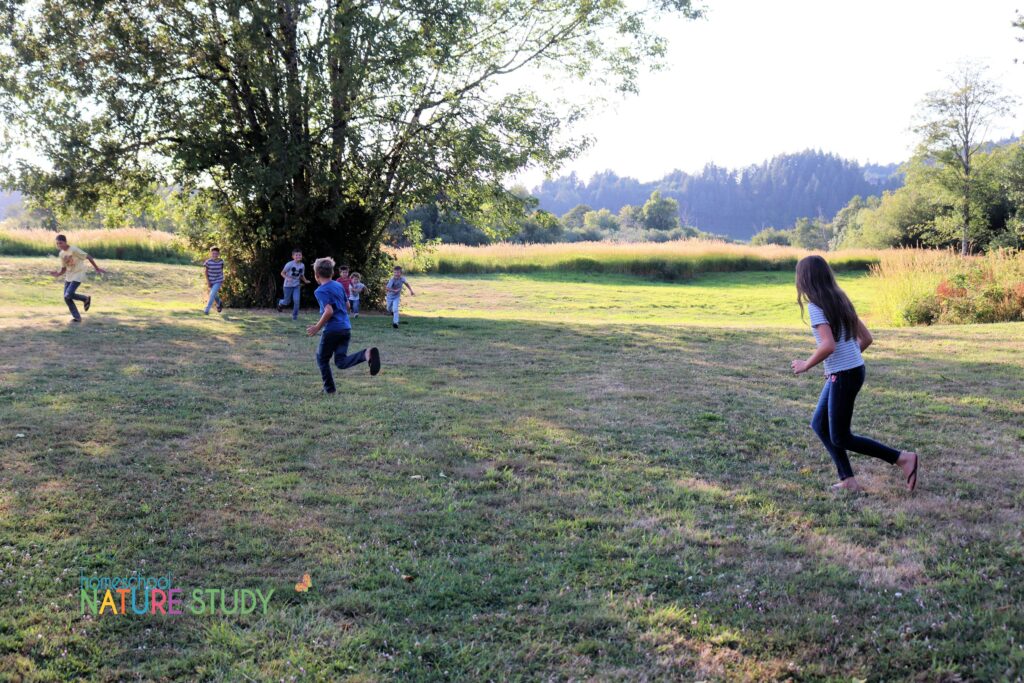
Sharks and Minnows is among one of our favorites. I love it because you don’t need any equipment, just a space large enough to run back and forth. There are several versions of Sharks and Minnows, but if this is your first time playing, I suggest beginning with the most basic rules.
Begin by setting your boundaries and safe zones; one safe zone on one end of the field and another on the other end. Pick one player to be the Shark, the rest are minnows. The minnows place themselves on the safe zone. The Shark places himself in the middle of the field. When he is ready, he calls the minnows out.
The goal of the minnows is to get safely to the other side of the field into the safe zone without getting tagged. Once they arrive at the safe zone, they are safe. If they are tagged by the shark, the minnows then turn into a shark and help tag the remaining minnows. When there is only one minnow left, it is time for the next round. The last standing minnow is the shark in the next round.
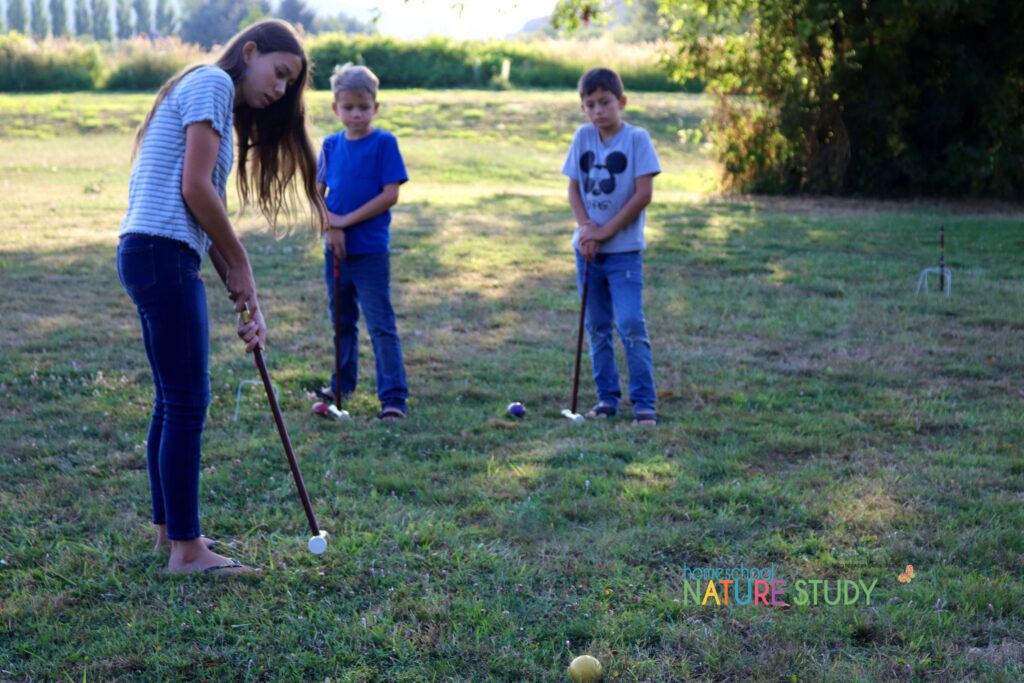
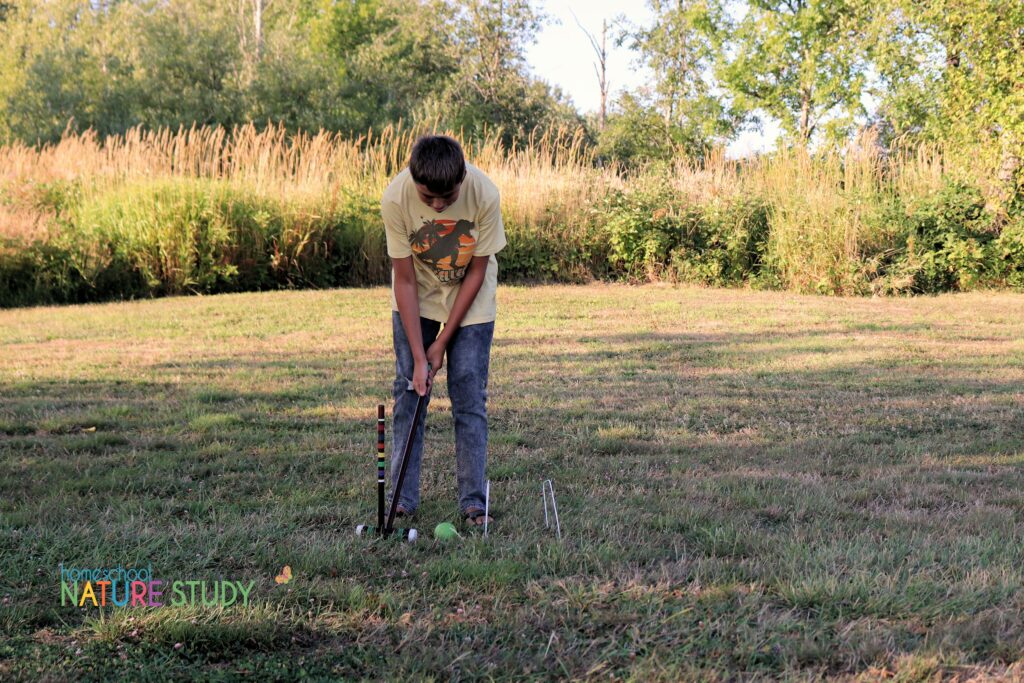
Croquette
This colorful game involves stakes, wickets, mallets, balls, and two to six players. Each player picks a colorful ball and a mallet to match. Players take turns hitting the ball through the wickets. The key is to make sure that the balls pass through the wickets and stakes in the correct order. The player who scores all fourteen wickets and two stakes wins!
Water Balloon Fight
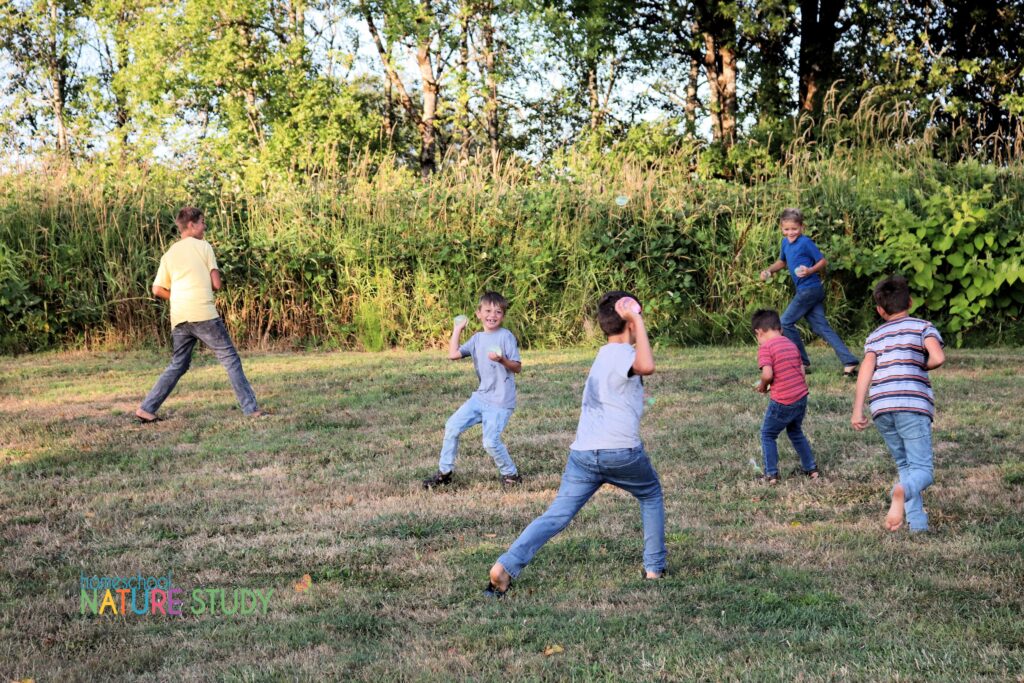
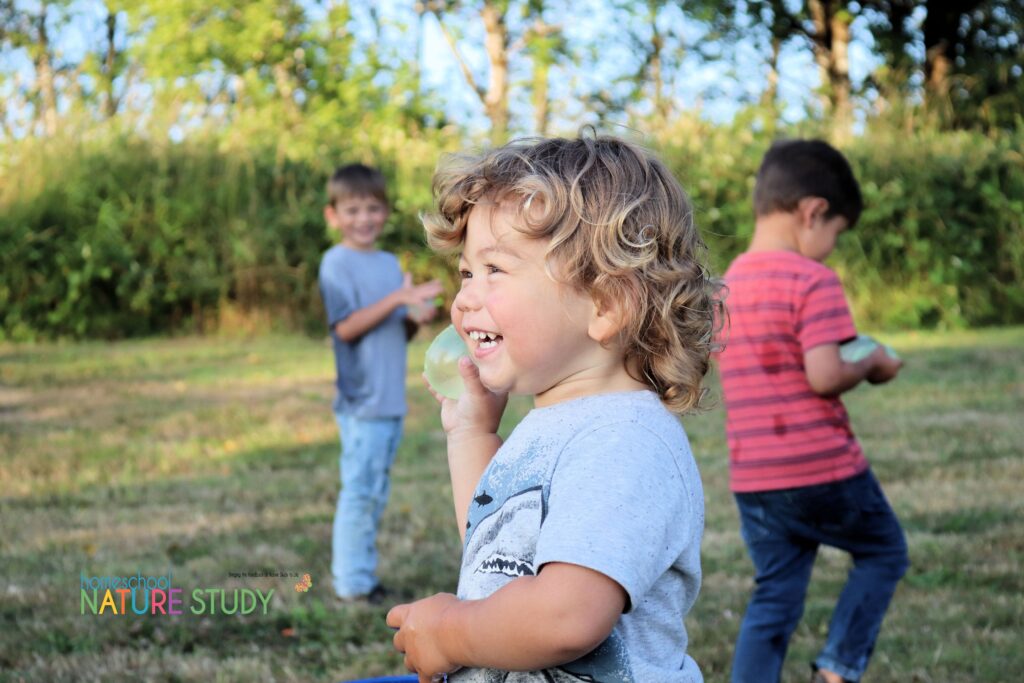
You can play so many games with water balloons! We love to simply fill up a lot of water balloons and throw them at one another. Although this game is a blast, we find it helpful to create boundaries before the fun begins. Each family is different and may need to tailor boundaries to fit their family size and dynamics.
On a Roll
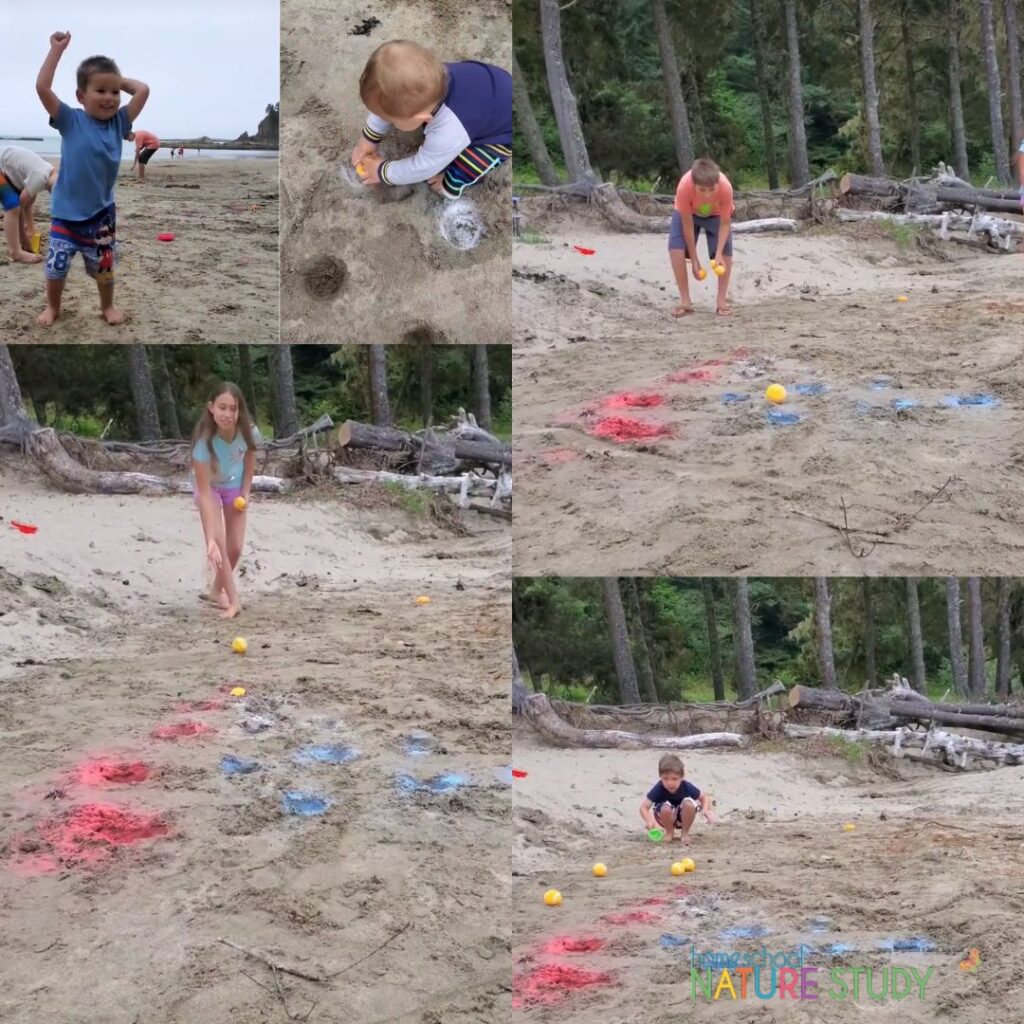
Homeschool Nature Study provides a link to this enjoyable game titled, On a Roll. It’s easy to create and is wonderful for fine and gross motor skills. Using a shovel (we used a plastic shovel that came with our beach toys), dig holes big enough to fit a tennis ball. We formed the holes very similar to the way bowling pins are set up; in a triangular pattern. Then roll the tennis ball and try to land it in the holes!
More Fun Outdoor Game Ideas
Tug of War
Hide and Seek
Eye Spy
Three Flies Up
Wiffle Ball
Homeschool Nature Study And Outdoor Play
Nature simply promotes outdoor play. When a child embarks on a journey outside, he has the freedom to explore, use his imagination, run in the grass, jump in a puddle, build a fort, touch a friendly frog, create. It’s delightful to watch a child engage in activities that are pure and lovely and learn at the very same time. Would you like to spend more time in nature with your children? Do you have a desire to make outdoor time a habit whether it’s participating in outdoor activities or simply taking a walk?
Unearth the benefits of spending outside time with your children and watch dynamic learning unfold with the Homeschool Nature Study membership. Homeschool Nature Study is designed to support your child’s healthy development, encourage outdoor time with your family, and nurture relationships. It’s equipped with endless outdoor hour challenges, courses, nature crafts, and an interactive nature calendar that keep children involved and engaged.
That’s not all! Getting outdoors isn’t beneficial just for children! It’s essential for us moms too. Homeschool Nature Study offers the Outdoor Mom Series just for mothers. Shirley Vels writes monthly devotionals that stir a time of quietness in our hearts, reflection, and the desire to slow down…even if it is for five minutes. Included are ideas for outdoor time for mom and nature journal prompts! You don’t want to miss it.
Be Inspired. Be Encouraged. Get Outdoors!
Jamie is the author of A Brown Bear’s Language Arts Study, a literature-inspired homeschool mom of eight, and a former educator. She enjoys a bookshelf bursting with colorful picture books and children’s stories of all genres. Indulging in a read aloud with all of her children around her is one of Jamie’s favorite moments of her days. Be sure to find Jamie on Instagram and visit her blog, Treasuring the Tiny Moments Homeschool, to be encouraged by all her learning adventures with her wonderful family.
Find nature studies on bees for all ages! Learn the different types of bees, visit a bee farm, play bee games, create a bee garden habitat or house and more!
An Awesome List of Nature Studies on Bees and Bumblebees
In an attempt to attract native mason bees to my garden, I purchased a mason bee house a few years ago. ( I purchased this one: Esschert Design WA02 Bee House which is my amazon.com link) It just seems to make sense to me to help support any local pollinator in my rather eclectic front yard habitat. There are plenty of bees already but lately I have been observing the insects more closely. In the past I have lumped all bees together, not really taking time to identify the various kinds of bees. Even when I took part in the Great Sunflower Project and counted bees, I really had a hard time noting the different types. If you are interested in some bee identification cards, you can find them at the Great Sunflower Project.
I am attempting to educate myself…love learning new things about the creation around me right in my own yard. So, after a little digging around, I stumbled upon some information that was new to me. I guess I always assumed that all bees lived in colonies. Wrong. There are many bees that are considered “solitary bees” and live as individuals, sometimes living next to each other but not in a hive.
Learn About the Types of Bees
Here are a few basics:
Leafcutter Bee:This bee cuts a clean bit of leaf to use in its nest. I have noticed leaves in my garden that may have been used by leafcutters and now you can be sure I will be looking even more carefully. Also, they gather pollen on their bellies and not in the pollen baskets on their hind legs.
Mason Bee:These are bees that use mud to construct their nests. They create the nest in hollow tubes like the one in my pre-made mason bee house. These bees are excellent pollinators. My research says they are out and about from May to late June or July.
Carpenter Bee: These bees make their nests in wood, usually rotting and old or damaged wood.
Tricia’s family enjoyed a backyard study of bees and investigated a carpenter bee, honey bee, paper wasp, yellow jacket and more! Checkout their Bees and Buzzy Insects Nature Study.
Learn About Bee Houses
Mason Bee House Video– interesting to watch this video showing five minutes of activity at the house.
Information on building a bee house: National Wildlife Federation. A bee house would be a wonderful addition to your wildlife habitat!
Preschool Science: Learning About Bees
As part of our farm unit study for this semester we’ve been visiting all types of farms. We recently visited a bee farm! We learned all about bees, honey and products made with beeswax! During the week we pulled out various bee books, printables, games and activities for a mini-unit on bees.
Bees are such wonderful and helpful creatures. From pollinating flowers to making honey, we could not live without them. Go ahead and explore the world of bees with your child, preschool class, daycare or homeschool co-op. Use these bee ideas as a science unit, a unit to go along with Letter of the Week or a spring-themed week. I’ve included free bee printable coloring sheets and games I’ve created for my children and local co-op class plus other fun ideas.
Learning about bees came at the perfect time for my family. I have one member who is not very fond of bees, so I figured learning more about them would help her have a healthy respect for these creatures as she learned about their importance in our ecosystem.
Honey Bee Farm Field Trip
Our Farm Field Trip group visited a large honey farm where we learned about bees from a bee keeper, tasted honey sticks, saw beeswax candles being made and even got to fill our own honey bottles.
This was a great field trip because we got to experience bees in a different way than we do in our back yard. The bee keeper was able to teach the students about bees, what to do when you are around them and why they are so important to have in our environment. He took a section of the hive and was able to show the students the honey comb, worker bees and the queen. He shared why he had to use the “smoker” while handling the bees (it throws off their communication.) And don’t worry— he was in a screened in tent with the bees while we watched from the outside. 🙂
Picking Up Pollen Bee Game
Supplies:
bouncy balls, ping pong balls or pom poms
bags
several small bowls
Bee Game Directions:
Flowers have pollen and that is just what bees love to collect. Set out several “flowers” with pollen (bowls, trays etc. filled with balls or pom poms) around the room.
Give each child a bag. Have them step into the handle so it is on one leg and place the other handle on their arm. This represents the sacks on the back of a bee’s leg that holds the pollen . (If that’s too difficult for the child, let them put it on their arm). Have the children collect the pollen and bring back to the hive (select a place to be the hive like a big tub to place all the “pollen”).
Female bees have a structure on their legs that no other insects, including wasps, have: a pollen basket. The basket is made of rows of stiff hairs that arch to form a hollow space on the outside of the bees’ legs, usually her back legs. When a bee visits a flower, she combs grains of pollen into her baskets. Pollen from the flower also sticks to the bee’s hair.
We have some toddler/preschool bee-themed printables by Maureen Spell in Homeschool Nature Study Membership! Members, log in and go to your Preschool Course to find a bee number count and a bee color match printable.
Our sister site, You ARE an ARTiST, has a variety of bee art lessons to enjoy! Including a fun, Winnie the Pooh and the Honey Tree art lesson.
Making a Bee Habitat
I have talked before here on the blog and in my newsletter about creating a wildlife habitat in your yard. This is something that has brought such joy to our family and I highly recommend getting started even if it is in a small way like hanging a mason bee house.
In homeschool nature study membership, find Outdoor Hour Challenges on bees, yellow jackets and mud daubers. Join us for even more homeschool nature studies for all the seasons! With a nature study plan for each week, you will have joyful learning leading all the way through the homeschool year for all your ages!
Enjoy these preschool printables alongside our Delightful Preschool Homeschool Nature Study Curriculum!
Do you like the idea of involving young children in nature study but not sure how to start? Do you need a little help being intentional with your nature studies? Nature Study Printables is full of printable tools for you to use to get young children observing and talking about nature!
Nature Study Printables For Toddlers And Preschoolers: An Overview
Nature Study Printables for Toddlers and Preschoolers is a 60+ page eBook containing all of our toddler and preschool nature study printables plus 20 exclusive pages available only in this book! Use these tools to help informally introduce young children to the natural world around them.
Table of Contents:
*Debunking Preschool Science Myths *Neighborhood Nature Walks with Young Children *10 Tips for Studying Nature with Toddlers and Preschoolers *Printable I Spy Cards
Animal Edition
Spring Edition
Garden Edition
Fall Edition
Winter Edition
*Printable Nature Booklets
Ants
Butterflies
Fish
Worms
Nature
Frogs
Ladybugs
F.A.Q.’s About Nature Study Printables For Toddlers And Preschoolers
Copypaper and cardstock. Basic supplies such as binoculars and a magnifying glass are fun tools to have on hand but are not necessary. If you don’t have frogs, butterflies, ants, worms, or ladybugs on hand to observe there are kits available for purchase.
How do you make the preschool nature journals?
How to make easy preschool science nature journals.
Fun Preschool Learning in Homeschool Nature Study Membership
Enjoy relaxed preschool nature study plans for your homeschool with nature table suggestions, simple nature study activities, field trip ideas, images to print, coloring pages, and so much more. What a privilege to introduce children to the glorious world God created!
Have children eager to be outside? You can think of the earliest years outdoors with your children as the way to grow a love and curiosity about the natural world. This habit develops gradually over their childhood. The earlier you start building a habit of nature study in your family, the easier it will be to encourage children to be engaged in nature study.
By Maureen Spell, a long-time contributor to the Outdoor Hour Challenges.Maureen helps Christian mompreneurs operate their business from a place of joy, purpose, and excellence because they are clear on how their business is serving their family and others. As a homeschool mom, she believes success at home AND business without the mom-guilt, stress and burn-out is possible! Outside of work, she loves having good conversations over a hot chai or GT Gingerberry kombucha and spending time with her husband and seven children. Visit her at MaureenSpell.com

This guide has everything you need for camping activities for kids. Includes ideas for preschool through high school.
Family Camping Activities for All Ages
You might want to start with the super simple ideas in our Backyard Camping: Fun for the Whole Family! If you have been reluctant to try camping, this is an easy way to test it out with your family closer to home. You may just end up liking it! Who knows where you will take your tent next? Make memories together that will last a lifetime.
S’mores are another natural start to family camping activities. Roasting marshmallows around the campfire is an experience we all need to check off our summer bucket list. Find an easy s’mores recipe here.
One fun family camping activity for kids is to plan a picnic! Even a snack in your backyard will make for a fun time together outdoors. You will be surprised at all you notice while you are outside.
Keeping your running Calendar of Firsts updated – mark the first campfire of the season and any other camping discoveries in your nature journal.
If you are camping towards the end of summer, you might enjoy this fun Last Days of Summer printable and have fun checking off the items!
Of course, camping in the backyard is fun but here are some ideas for nature study while you travel for your camping adventures.
You might want to take along the book, Last Child in the Woods, to read while you are camping!
And if you’d like to skip the mosquitoes all together, consider Online Summer Art Camp with our sister site, You ARE an ARTiST, for some really fun activities including a treasure map, a camp song, your own backyard tent site and campfire.
The Curriculum Choice also has a great round up of summer camp fun for your family.
Enjoy a family homeschool river study finding crawdads and crayfish!
Have a creek near by? What a great way to make memories together. This study is part of Homeschool Nature Study membership and is so much fun!
Camping Activities For Kids: Toddlers and Preschoolers
This summer, many families will be joining the Great American Backyard Campout. In honor of that event, I thought I’d share some toddler and preschool camping activities you can do camping at a camp ground or in your own backyard. Here are five toddler and preschool camping activities to keep your kids exploring and entertained:
Even my 19mo. old was able to join in our treasure quest. She was quite proud of all the rocks she found.
1. Nature Walks and Nature Treasure Hunts
Sometimes we use our printable Nature I Spy cards when on our hikes, or we have a certain object that is the “treasure” of the walk that we must find. On this particular walk we were looking for rock and sea shell treasures (Be sure to know the rules of the campground and whether or not you can remove items found in nature.) Find printable Nature I Spy cards in Homeschool Nature Study membership.
My 3yr. old was thrilled whenever she found a shell. It’s not every day that we find shells in the Midwest.
2. Nature Crafts: Create Nature Sculptures
Now I had a specific purpose in mind when we went on our various treasure hunts. We were going to use these nature treasure to make nature sculptures.
I made a batch of lavender playdough ahead of time and brought it with. The girls used this to make various sculptures and imprints of the objects they had collected on our nature walks. For the lavender playdough recipe, check out Sun Hats & Wellies post on making natural nature playdough.
3. Outdoor Games For Kids: Rock Memory Game
My 19mo. old was so good at collecting rocks that we had enough to make our own rock memory game!
I just used a Sharpie marker to make simple designs on the rocks and flipped them over for an easy game of memory!
4. Bandana Bingo
I found these Bandana Bingo games a few years ago and love how easy they are to carry along on a hike or camping. We own Bug Bingo, but there are other boards available. This is fun to play in teams and see who can find the most items on the grid.
5. Camping Clipboards
Each of my children have their own clipboard (afflink) that stores paper and pencils. I fill these clipboards with blank paper, some printed activities such as the nocturnal animals sort, and a couple of pencils. Sometimes they draw their nature treasures, do tree bark rubbings, or just doodle. They love their clipboards and I’m thankful for a quiet sitting activity that they can do.
Camping Activities for Older Children
Oregon Camping – some beautiful tidal pools, beach and trees to explore!
Homeschool Nature Study Printables for Toddlers and Preschoolers
Do you like the idea of involving young children in nature study but not sure how to start? Do you need a little help being intentional with your nature studies? Nature Study Printables is full of printable tools for you to use to get young children observing and talking about nature!
Nature Study Printables for Toddlers and Preschoolers is a 60+ page eBook included in Homeschool Nature Study Membership containing all of our toddler and preschool nature study printables plus 20 exclusive pages available only in this book! Use these tools alongside Homeschool Nature Study Preschool Curriculum to help informally introduce young children to the natural world around them.
Homeschool Nature Study Membership
Join us for even more homeschool nature studies for all the seasons! With a new nature study each week, you will have joyful learning leading all the way through the homeschool year for all your ages!
Do you have any family camping or camping with toddlers and preschoolers tips? Will you be doing a backyard campout this year?
By Maureen Spell, a long-time contributor to the Outdoor Hour Challenges.Maureen helps Christian mompreneurs operate their business from a place of joy, purpose, and excellence because they are clear on how their business is serving their family and others. As a homeschool mom, she believes success at home AND business without the mom-guilt, stress and burn-out is possible! Outside of work, she loves having good conversations over a hot chai or GT Gingerberry kombucha and spending time with her husband and seven children. Visit her at MaureenSpell.com
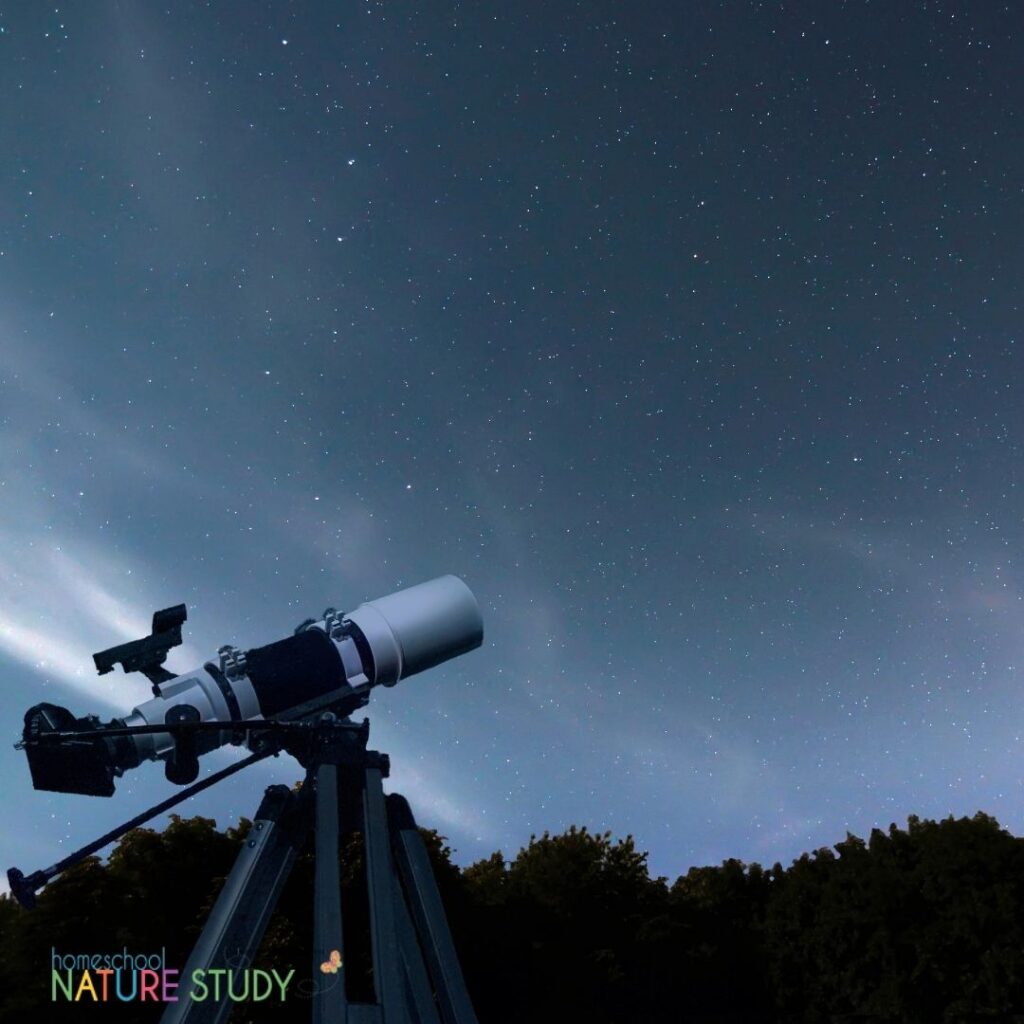
Backyard Camping with The Great American Backyard Campout
Each year, The National Wildlife Federation sponsors the Great American Backyard Campout and you are invited. From their website,”Spend the night under the stars with National Wildlife Federation and take your family’s first step into a lifetime filled with healthy, outdoor fun.”
If you have been reluctant to try camping, this is an easy way to test it out with your family closer to home. You may just end up liking it! Who knows where you will take your tent next?
I know that sleeping outdoors can seem scary and unfamiliar but overcoming the fear of being outside at night is worth the effort. You will realize there are some amazing things going on between sunset and sunrise right in your own backyard!
Combine nature study with an overnight backyard campout and you will build family memories that last a lifetime.
Nature Study Ideas from the Outdoor Hour Challenge for Backyard Camping Fun
Stars and Moon (winter study you can adapt – Winter Curriculum)
Sounds (Summer Curriculum)
Night Blooming Flowers (Summer Curriculum)
Pick a challenge, read the pages in the Handbook of Nature Study, and then look for an opportunity to apply what you learned. Keep it fun and always, always, always follow your child’s lead if they find something they are interested in. You can follow up with a library book or a Google search in the morning.
Bring a few art supplies outdoors and your nature journal so you are prepared if you find something of interest. If you have a nature related storybook or a favorite outdoor adventure book, bring it out for some after dark reading with a flashlight.
More than anything else, be aware of your surroundings and use all your senses, when you can’t rely on your vision…listen, feel, and smell the nighttime in your backyard. Try to spend a few minutes just sitting quietly in the dark if your children are able and see what you notice. Even a few seconds of quiet is good for younger children.
Summer Nature Study with Homeschool Nature Study Membership
Join us for even more homeschool nature studies for all the seasons! With a new nature study each week, you will have joyful learning leading all the way through the homeschool year for all your ages!
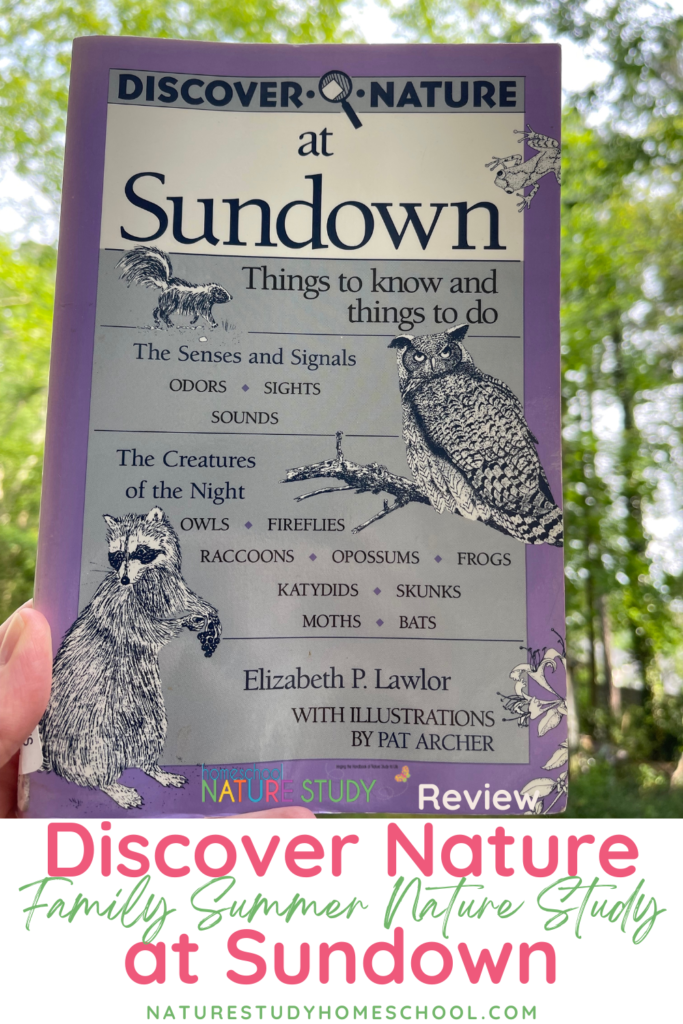
Wondering about the summer nature study book, Discover Nature at Sundown? This helpful review includes a fantastic idea (and free printable!) for families to take a nature walk in the evenings.
Discover Nature at Sundown: Family Summer Nature Study
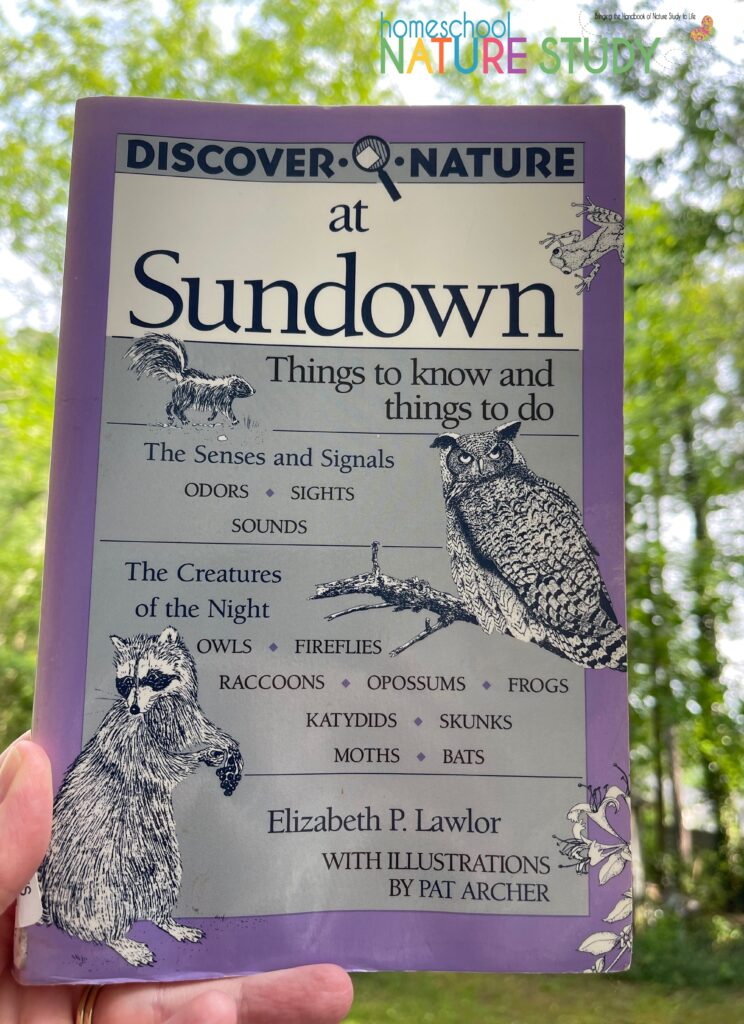
Discover Nature at Sundown by Elizabeth P. Lawlor is a book that our family has used for many years. When my children were younger, we would pull it off the shelf every summer to use as a reference and as a source of nature study ideas.
Our Summer Nature Study Curriculum features Discover Nature at Sundown and its topics, which you can find referenced below (Summer Series of Outdoor Hour Challenges).
Main Topics in Discover Nature at Sundown
Here are some of the many topics you can enjoy in your summer nature study:
owls
frogs
moths
fireflies
bats
opossums
raccoons
and skunks
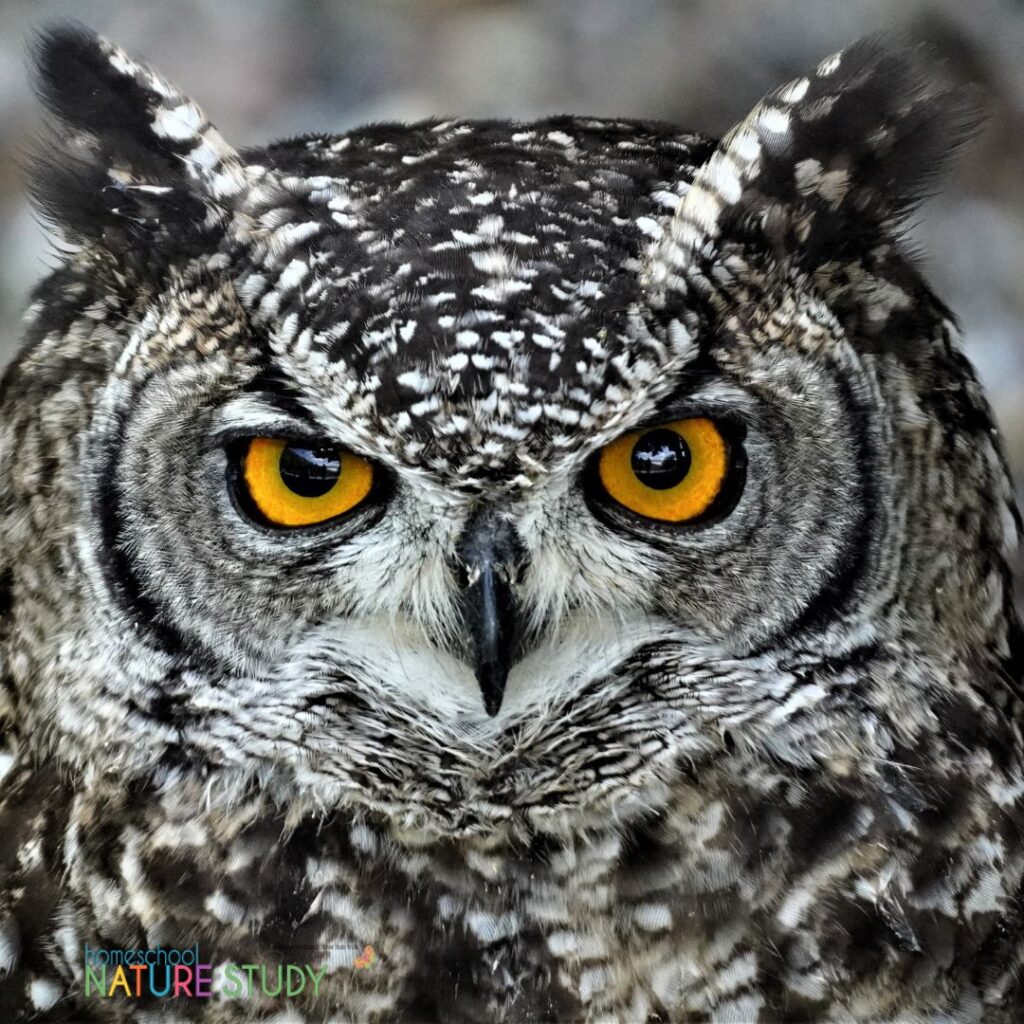
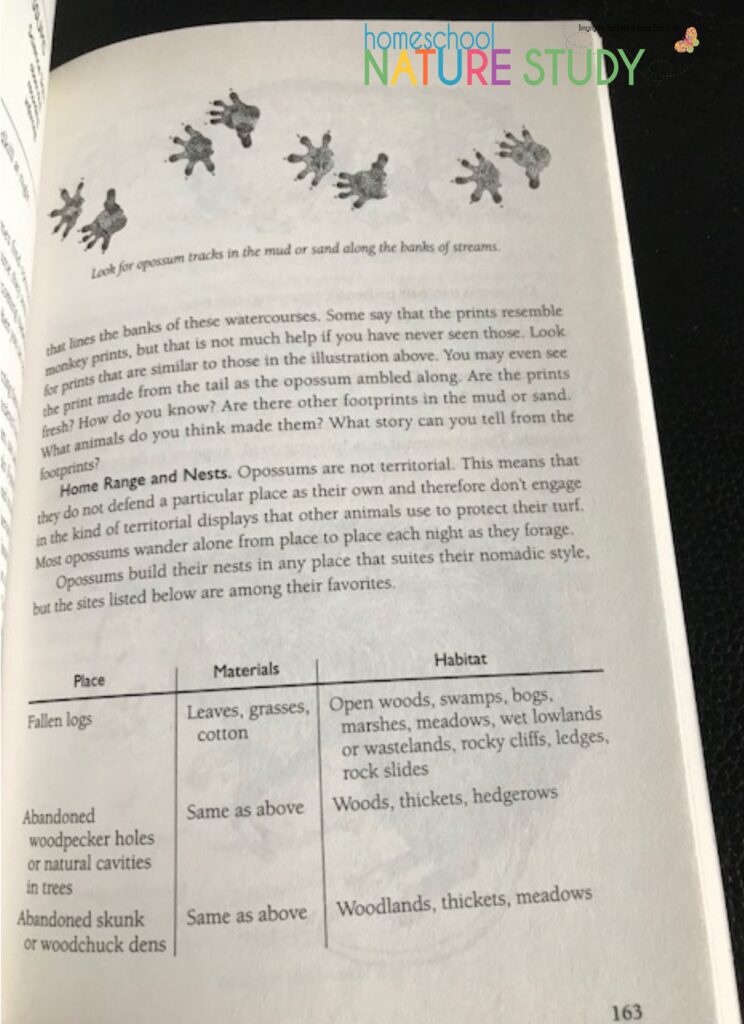
There’s a little something for everyone’s taste! Dissect an owl pellet, try to entice moths to your nature hike, chase a firefly, listen for crickets, or hunt for traces of raccoons and opossums. My strategy was always to complete an entire in-depth study from this book each summer. Over time, your family will have covered a lot of interesting topics in a relaxed and enjoyable way.
Great Ideas for Summer Nature Journaling
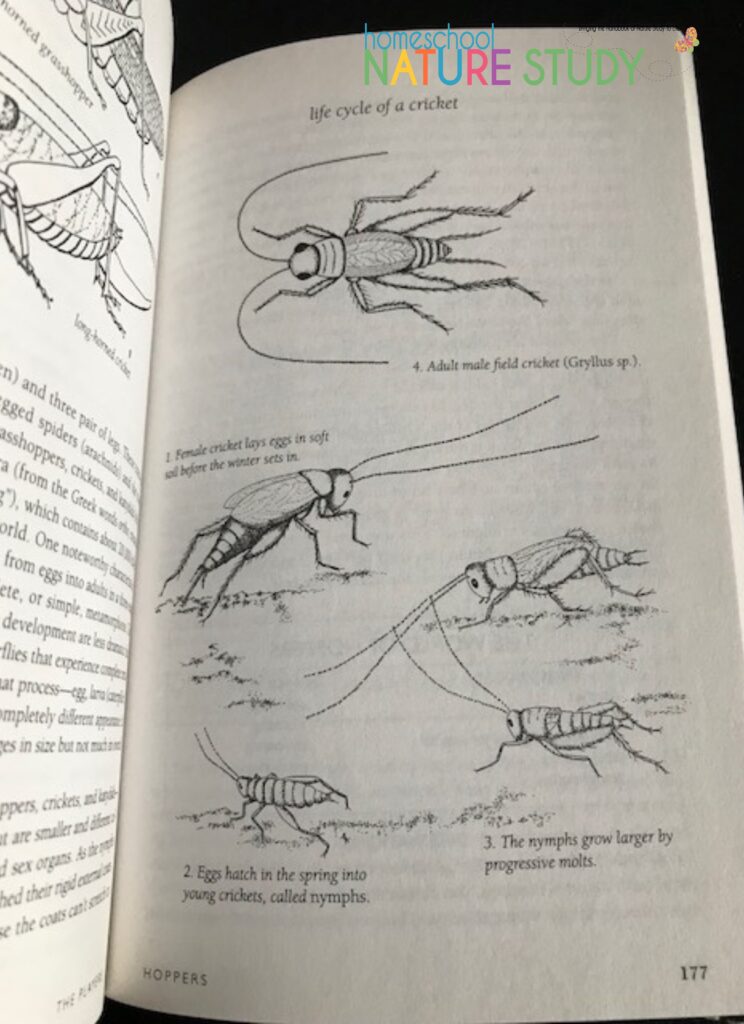
For those of you that keep nature journals, you’ll be happy to note that the illustrations and charts are all very well done and our family would often copy them into our nature journals for future reference. The black and white line drawings are simple enough to inspire even the most reluctant nature journaler.
The ideas in this book will help you use your senses during your nature study to learn more about each of the topics. These skills are so useful in all scientific study but especially so for nature study. Plus, using all your senses is lots of fun! The book will help you with ideas for honing these skills and explain how we can enhance our natural senses.
Take a Sunset Nature Walk – A Fun Way to Work on Using Our Senses
Summer evenings are a cooler time of day for getting outside with your children. The after dinner hours are still light enough that taking a nature walk is a possibility.
You could go on a dinner picnic at a lake and then take a long walk in the evening air. There will still be plenty of things to observe, including a delightful sunset, the chirping of crickets, the song of the robin, the breeze in the treetops, and the buzz of mosquitoes.
Your nature walk doesn’t need to be a long one and you can adjust the time of day and length to fit your particular family. For a first outing, plan on 15-20 minutes and then see how it goes. If you can encourage your children to walk silently, even for just a minute, they are going to get more out of the experience. As your children are able, try to spend longer periods of silence as you listen for any signs of life during your outdoor time.
Take a Nature Hike at Sundown Printable
This printable is also available to Homeschool Nature Study members in your Summer course. Please be sure to share photos of your sunset walk and tag us on Instagram @outdoorhourchallenge
Summer Nature Study in Homeschool Nature Study Membership
Join us for even more homeschool nature studies for all the seasons! With a new nature study each week, you will have joyful learning leading all the way through the homeschool year for all your ages!
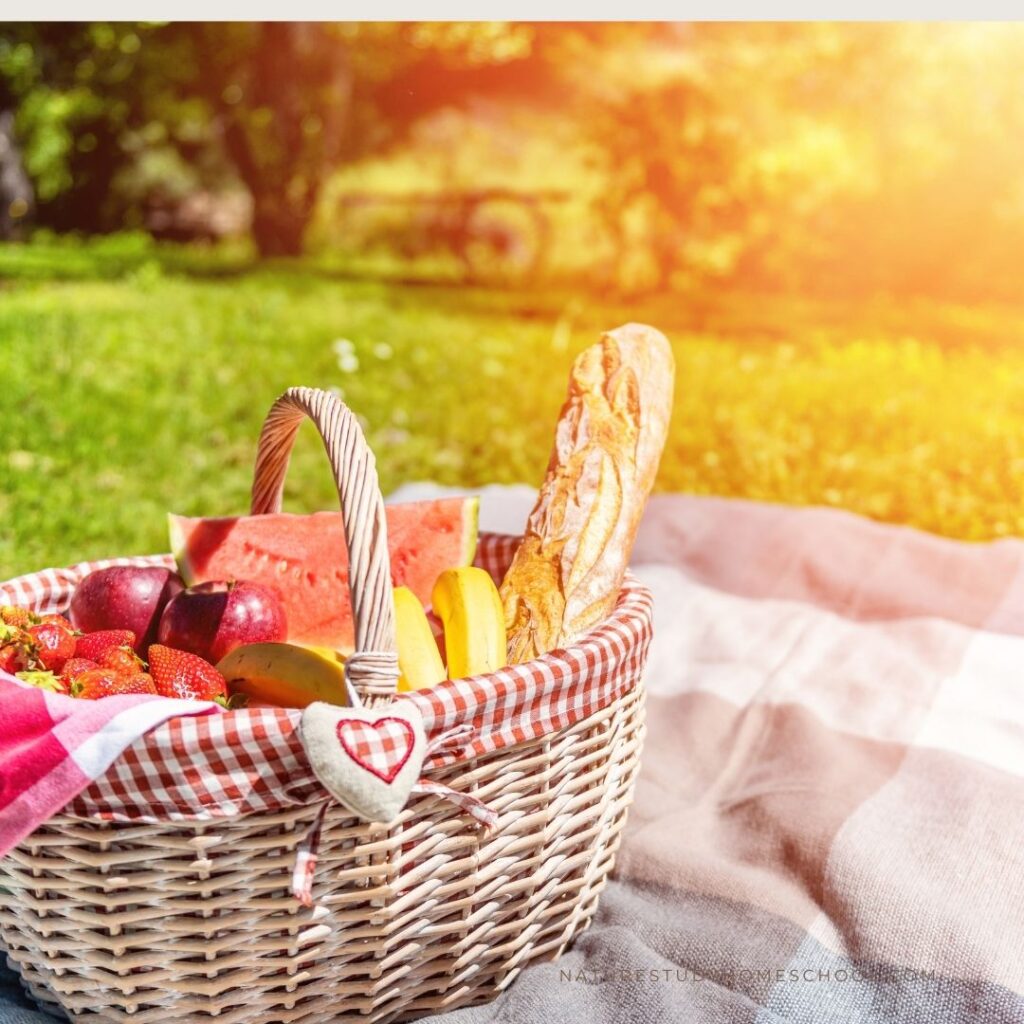
You can plan a simple outdoor picnic with the benefit of homeschool nature study! Even a snack in your backyard will make for a fun time together outdoors. You will be surprised at all you notice while you are outside.
“..by beginning with the child in nature-study we take him to the laboratory of the wood or garden, the roadside or the field, and his materials are the wild flowers or the weeds, or the insects that visit the goldenrod or the bird that sings in the maple tree, or the woodchuck whistling in the pasture.”
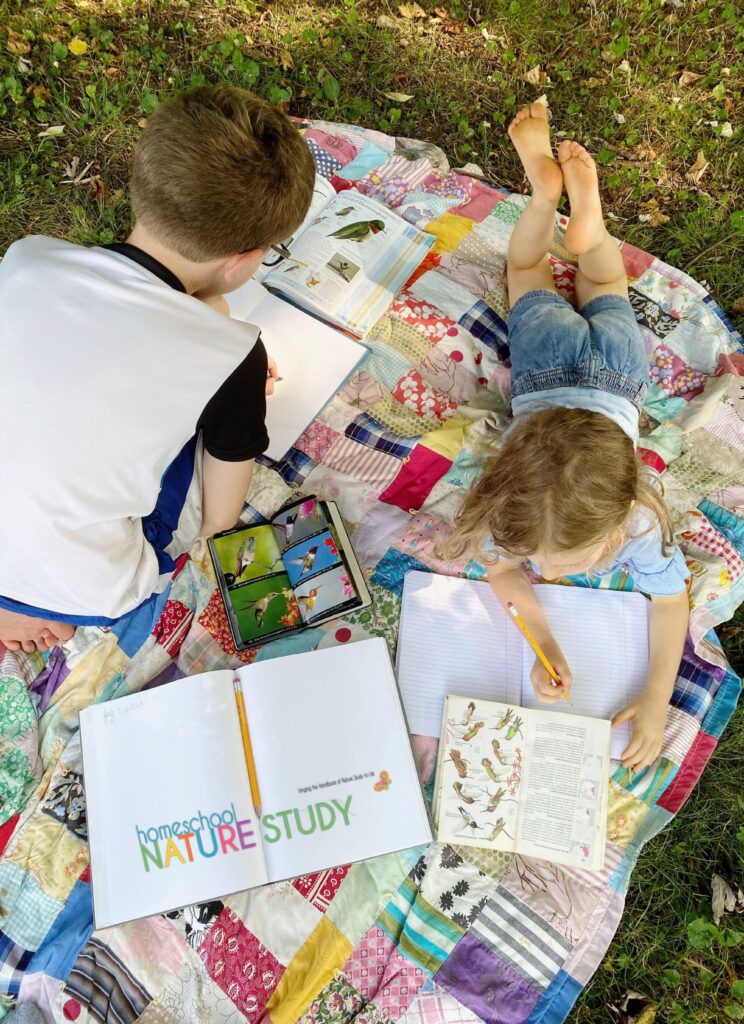
Picnics don’t need to be fancy. Wrap up a sandwich in a cloth napkin, grab a piece of fruit, and some water and you are set. Venture outside even if it is only to your own yard to sit on a blanket and enjoy your lunch. Afterwards you can make time for a short period of nature study.
I love eating outside with my family, especially in the summertime. This week’s Outdoor Hour Challenge encourages you to share a meal outside with your children. Keep it simple as far as food selections and location. Even if all you do is put a few things in a bag, grab a blanket, and then spread it all out on your own backyard lawn, I’m sure you and your children will enjoy the fresh air and the time spent outdoors sharing a meal.
Our family looks back fondly on the meals we shared outside in the summertime on our back deck. It made us slow down a bit and take notice of the things that happen outside like clouds floating by, birds chirping, and trees swaying in the breeze. We watched loads of sunsets and I remember a few times being sprinkled on by a passing late afternoon thunderstorm.
Our family eats dinner outside every night from June to September….longer if the weather allows. We have arranged our patio table under a canopy and the citronella candles are always kept nearby. We have a tree that the hummingbirds sip nectar from in the dusk hours and after our meal we sit and observe their dinnertime.
“…When the weather is warm, why not eat breakfast and lunch outside?…Besides the benefit of an added hour or two of fresh air, meals eaten outside are often delightful, and there’s nothing like happiness to convert food and drink into healthy blood and bodies.“
Charlotte Mason, Outdoor Life pg 43
Summer Nature Study Tip
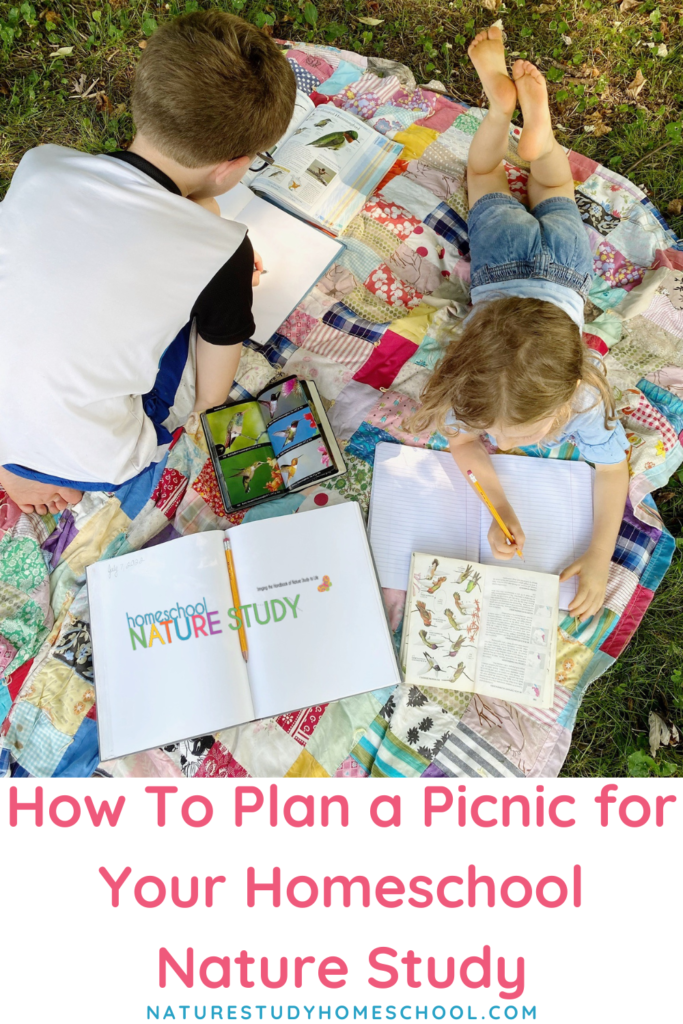
Purchase some inexpensive, unbreakable dinnerware and reusable utensils. Make sure you have a small ice chest and some cooler packs to pop into your freezer. Gather a blanket or camping chairs to leave in your garage for those last minute excursions to the park for a picnic. Make sure to bring your nature journal and some pencils so you can create a nature journal page if the opportunity arises during or after your picnic.
Outdoor Hour Challenge Picnic
1. The challenge is to have a picnic. No need to go far or to even have a picnic table. Food always tastes better outside and if you don’t want to commit to a whole lunch, why not just a snack?
After you eat, sit and listen to the sounds of the spring.
“Given the power of nature to calm and soothe us in our hurried lives, it also would be interesting to study how a family’s connection to nature influences the general quality of family relationships. Speaking from personal experience, my own family’s relationships have been nourished over the years through shared experiences in nature-from sharing our toddler’s wonder upon turning over a rock and discovering a magnificent bug the size of a mouse, to paddling our old canoe down a nearby creek during the children’s school years, to hiking the mountains.”
2. After your picnic, spend 10-15 minutes observing your surroundings. Add anything new to your list of items observed in your focus area that you are keeping in your nature journal. Make note of any additional research that needs to be done for things your child is interested in. Make a journal entry if you wish.
This challenge is found in the Getting Started ebook which is included in Homeschool Nature Study membership. The ebook provides the challenge as shown above as well as custom notebook pages for your follow up nature journal if desired.
Homeschool Nature Study MembersHave Great Resources at Your Fingertips
Consider working through the first three Outdoor Hour Challenges in the Getting Started ebook. These three challenges can help build your nature study habit. I highly recommend following the suggestions for reading in the Handbook of Nature Study that go along with those challenges. The words expressed in those readings include timeless advice to parents about the value of regular nature study close to home. Make sure to have the printable nature journal pages bookmarked in case your child is ready to create a record of their Outdoor Hour Challenge.
#1 Let’s Get Started #2 Using Your Words #3 Now Is The Time To Draw
Look for the Outdoor Hour Challenge Planning Pages printable in the Planning Resources course. Use these pages to make a rough plan for your nature study.
If you’re not a member here at Homeschool Nature Study yet, please consider joining to gain the benefit of having a nature study library at your fingertips. There are numerous resources available for you to help create the habit of nature study within your family.
Enjoy relaxed preschool nature study plans for your homeschool with nature table suggestions, simple nature study activities, field trip ideas, images to print, coloring pages, and so much more. What a privilege to introduce children to the glorious world God created!
Have children eager to be outside? You can think of the earliest years outdoors with your children as the way to grow a love and curiosity about the natural world. This habit develops gradually over their childhood. The earlier you start building a habit of nature study in your family, the easier it will be to encourage children to be engaged in nature study.
Don’t miss the free sample of preschool curriculum, below!
Delightful Preschool Nature Study Plans for Your Homeschool
Preschool nature ideas for each month of the year include:
an animal, bird, flower and tree of the month – that is four nature studies each month!
nature table suggestions and items for free play
image cards
monthly activities
library books suggestions
casual monthly nature study
preschool hands on activities for active learning: singing drawing, tasting
“..the mother must not miss this opportunity of being outdoors to train the children to have seeing eyes, hearing ears and seeds of truth deposited into their minds to grow and blossom on their own in the secret chambers of their imaginations.”
Charlotte Mason, Volume 1, page 45
These Outdoor Nature Study Plans Can Be Used Family Style
Most of these nature study plans point to existing Outdoor Hour Challenges in our membership. The new Preschool course includes nature studies plus the plans refer to spring, summer, autumn and winter topics.
These are studies the whole family can explore! So these preschool plans are a great place for the whole family to start with.
48 Outdoor Hour Challenges!
But what if there is a rainy day and you can’t get outdoors? The activities in our Preschool Nature Study Plans will give you new ideas for fun learning.
Sample a Month of Nature Study Plans For Preschool
Try a free sample of the preschool nature study plans included in Homeschool Nature Study Membership. This sample includes a month of nature study plans! Get your copy in the form, below:
Preschool Nature Study Curriculum Included in Homeschool Nature Study Membership
Our Preschool Nature Study Curriculum is the newest addition to the Homeschool Nature Study membership. There are even more resources coming to members in the coming months!
There are 25+ continuing courses with matching Outdoor Hour curriculum that will bring the Handbook of Nature Study to life in your homeschool! In addition, there is an interactive monthly calendar with daily nature study prompt – all at your fingertips!
Join us for even more homeschool nature studies for all the seasons! With a new nature study each week, you will have joyful learning leading all the way through the homeschool year for all your ages!
This Nature Study curriculum written by founder, Barbara McCoy. Additional resources by Tricia.Tricia and her family fell in love with the Handbook of Nature Study and the accompanying Outdoor Hour Challenges early in their homeschooling. The simplicity and ease of the weekly outdoor hour challenges brought joy to their homeschool and opened their eyes to the world right out their own back door!She shares the art and heart of homeschooling at You ARE an ARTiST and Your Best Homeschool plus her favorite curricula at The Curriculum Choice.
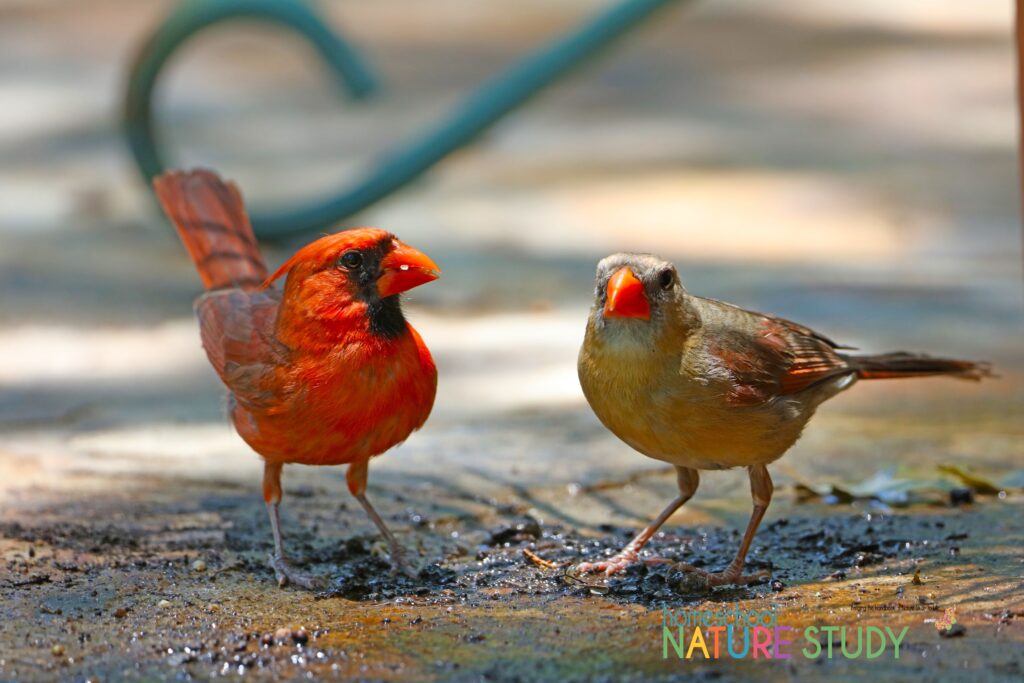
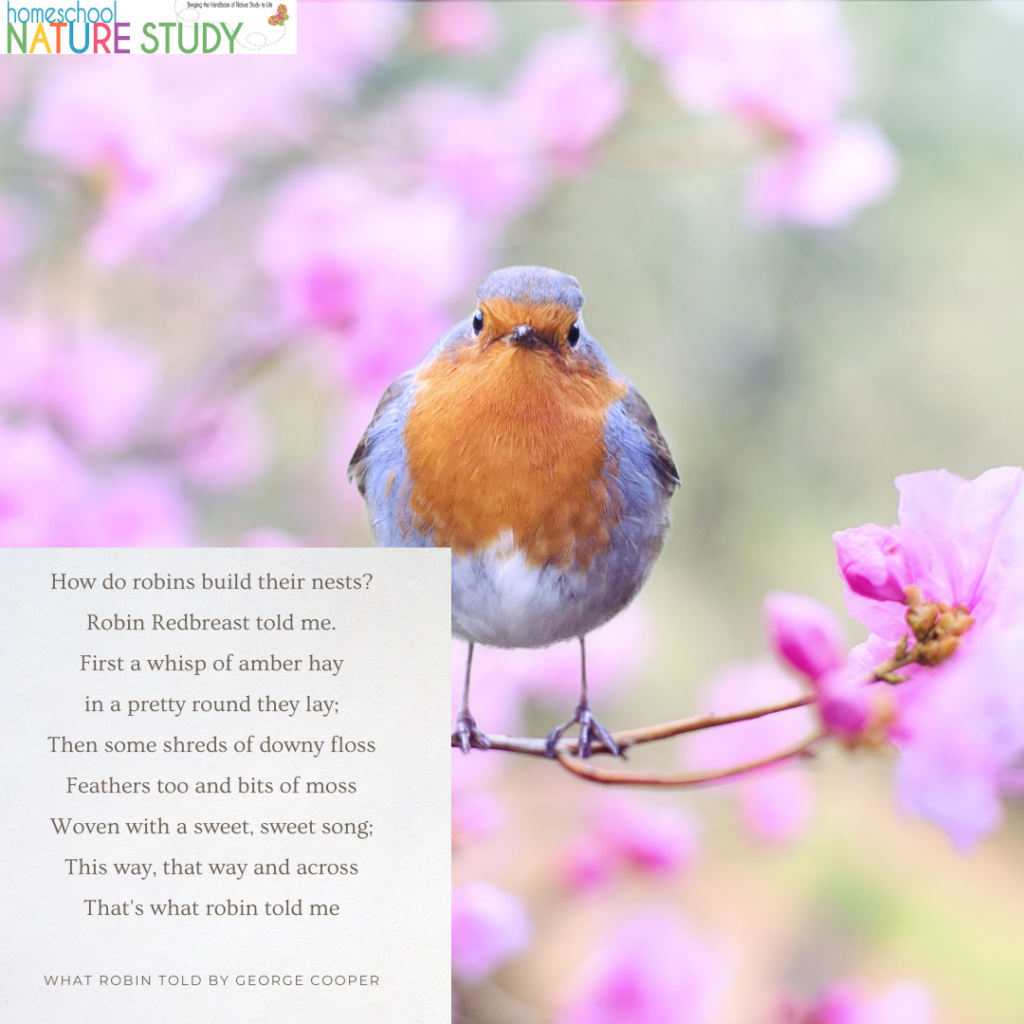
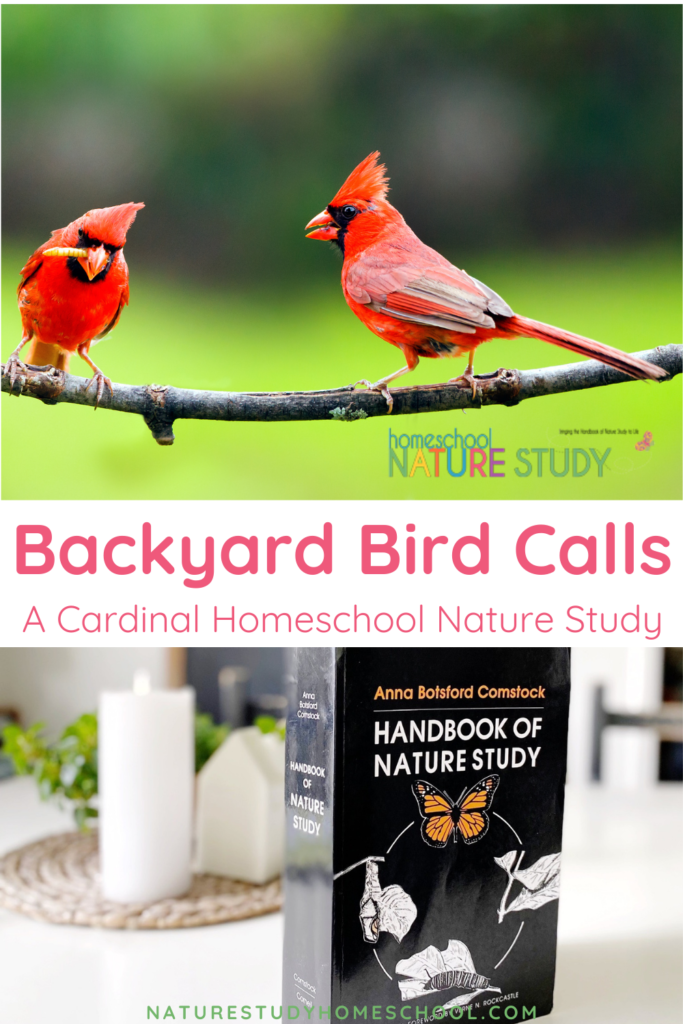
Enjoy an easy way to learn backyard bird calls. Then use the homeschool nature study on the robin, cardinal and house finch to discover even more!
I thought it would be fun to start to learn some bird calls. Our family is going to try to learn the calls of the birds from the Outdoor Hour Challenge. I have one son that definitely learns things well when we make them into a song so I thought this would be a fun project for him to do.
Learn Backyard Bird Calls: Robin, Cardinal and House Finch
If you would like to join us, here are the links to a website where you can hear the bird calls.
Robin, Cardinal, and House FinchNature Study for Your Homeschool
No need to stop at the backyard bird calls! This series of Outdoor Hour Challenges is going to help you study birds, their habits and their unique features. Learning to really see the parts of the bird in order to not only identify it but to see how each bird fits into the overall world of animals. I have decided to emphasis the most common backyard birds.
YourInside Backyard Bird Homeschool Nature Study Time:
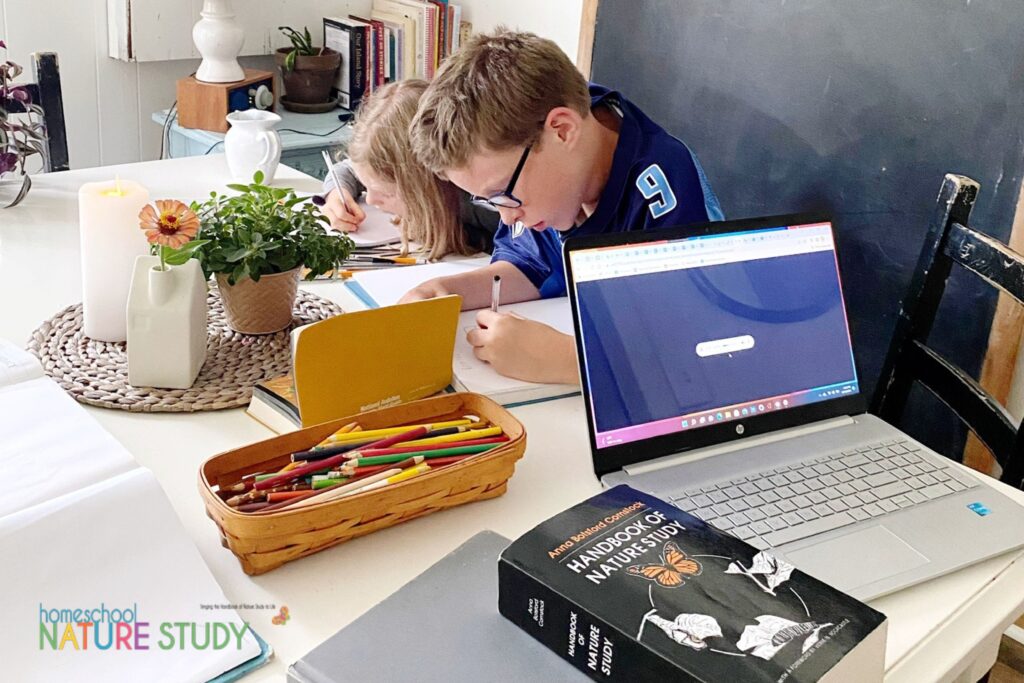
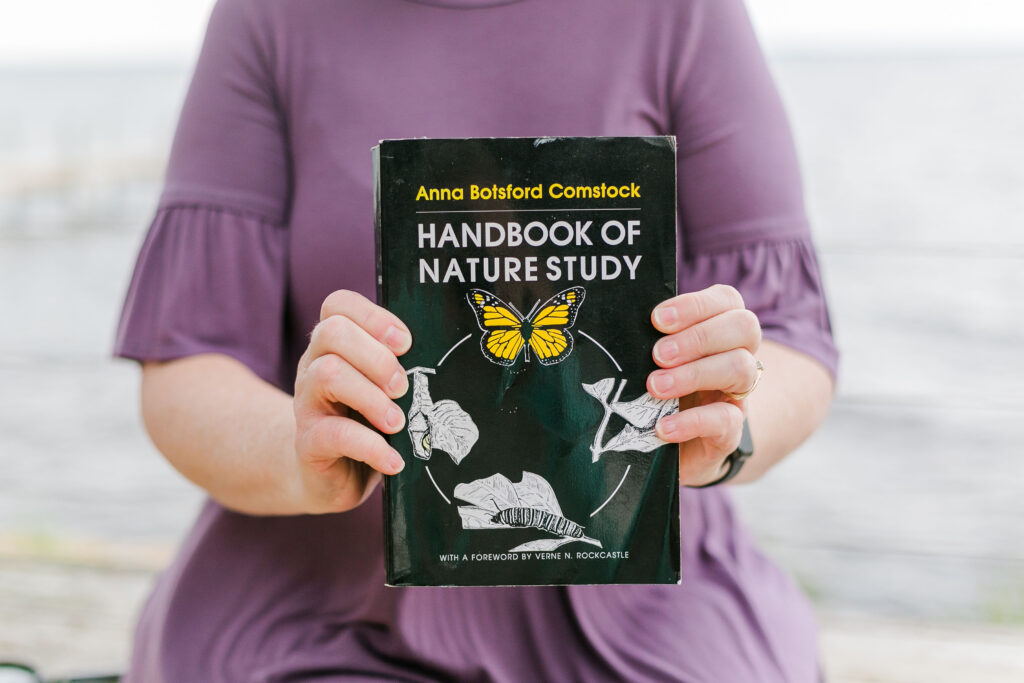
1. Read the Handbook of Nature Study pages 27-28 to get a general overview of bird study using this book. In addition, read pages 43-44 for some ways to attract birds to your yard. I highly recommend hanging a feeder of some sort and providing water as well.
2.Read in the Handbook of Nature Study pages 57-62 about the robin. There is so much information about the robin on these pages that it is a little overwhelming. I would read the information and mark any ideas or facts that you are interested in sharing with your child. 3. Read in the Handbook of Nature Study pages 127-130 about the cardinal grosbeak.
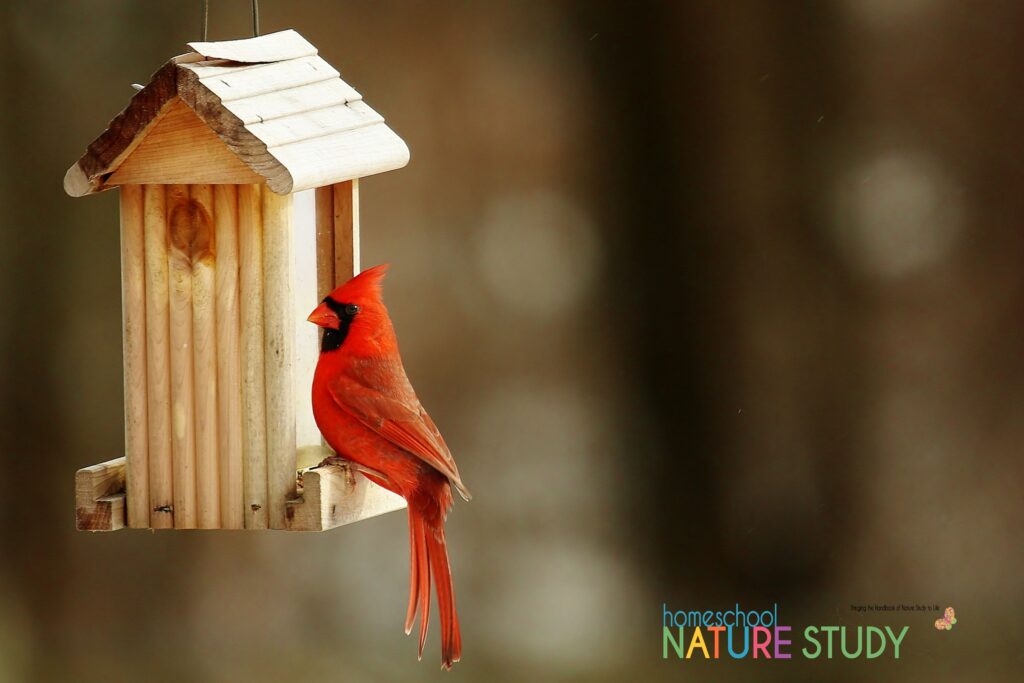
4. Backyard Birds: Read aloud with your child the introductory pages and the section on red birds: the robin, the cardinal, and the house finch. Take note of each bird’s field marks for future reference. Notice the difference between the female and male birds for each kind of bird.
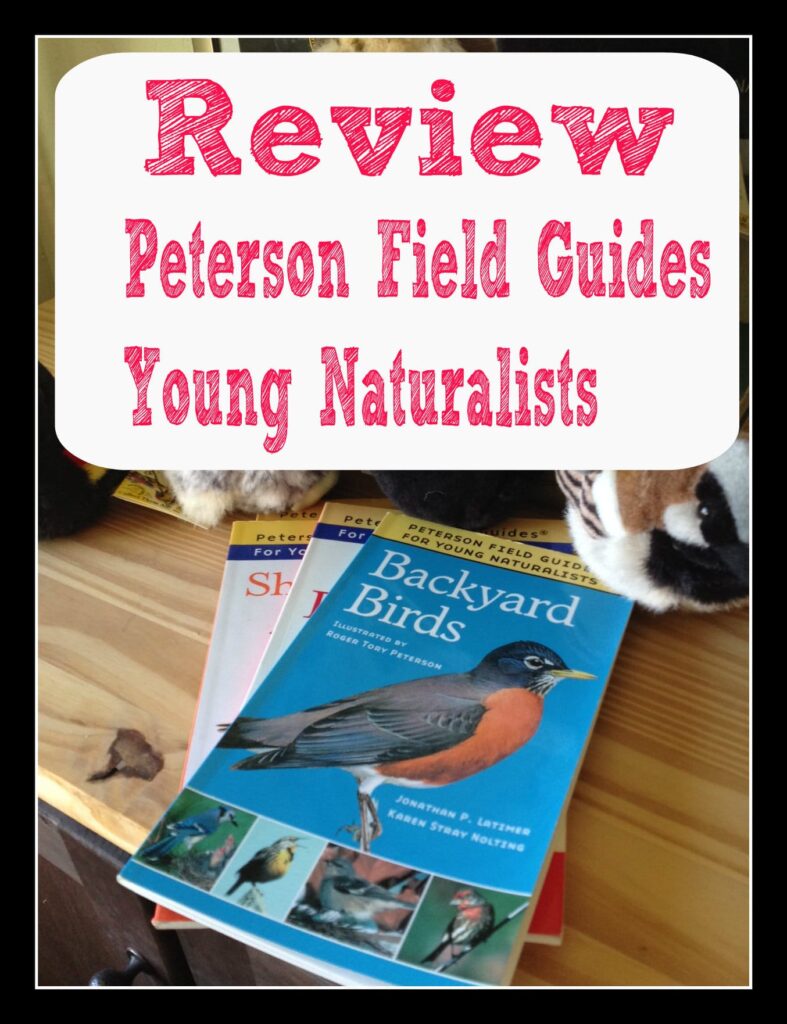
5. Peterson Field Guide: Backyard Birds: Read the introductory pages 17-22(W) or 23-30(E). Look up in the index the robin, the cardinal, and the house finch. Observe the illustrations carefully and read the narrative descriptions and explanations.
Please Note: (W)=Western Birds and (E) Eastern Birds
YourOutdoor Hour Time
Take your 10-15 minutes of outdoor time to enjoy your own backyard. Since this series of challenges is about birds, be aware of any bird subjects that come your way. This could include feathers, nests, bird tracks, or the sounds of bird calls.
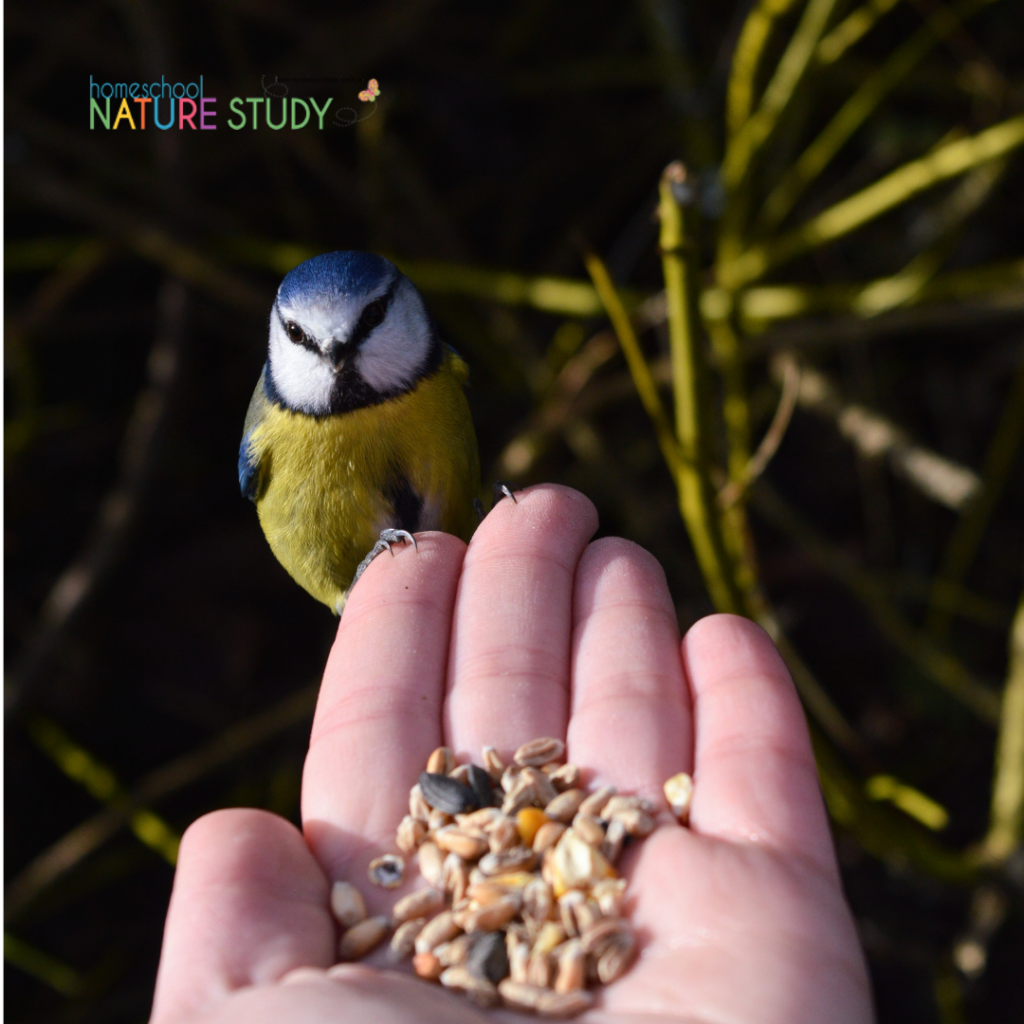
You could also use your outdoor time to hang a bird feeder and talk about what kinds of birds you hope to attract. You could talk about the different kinds of seeds. The more you include your children in the process of setting up the bird feeder, the more excited and invested they will be to watch for birds to visit.
Your goal this week is to spend the time outdoors with your children and perhaps observe a bird. What particular aspect of the bird are you observing this week? How about the color, size, and shape of the beak? This should get you started in your bird study.
Follow Up Bird Homeschool Nature Study Activities
For your follow up activity you can learn more about the particular bird that you observed. If you know what kind of bird it is, look it up in the Handbook of Nature Study for more information. You can also use the Peterson Field Guide or an internet resource such as whatbird.comor Cornell’s bird website.
The above websites also can help you identify an unknown bird. We will be learning in the upcoming challenges how to use a field guide to identify birds so don’t worry if you don’t find an exact identification for your bird.
The most important part of this challenge is getting outdoors with your children and beginning a search for birds. If you have a nearby park, you can try visiting there during your week to see if there any different birds for observation. Many parks have ducks and geese that make excellent subjects for bird study.
More Bird Nature Study Activities for Your Homeschool
Birds are such a joy to learn about. Here are some more bird nature studies you can enjoy!
Hopefully during your outdoor time you found something to investigate further. Questions are always a great way to extend your nature study to other days of your week.
This red bird challenge is from the Birds Course in our Homeschool Nature Study membership using the Handbook of Nature Study. You can purchase a membership now and have instant access.