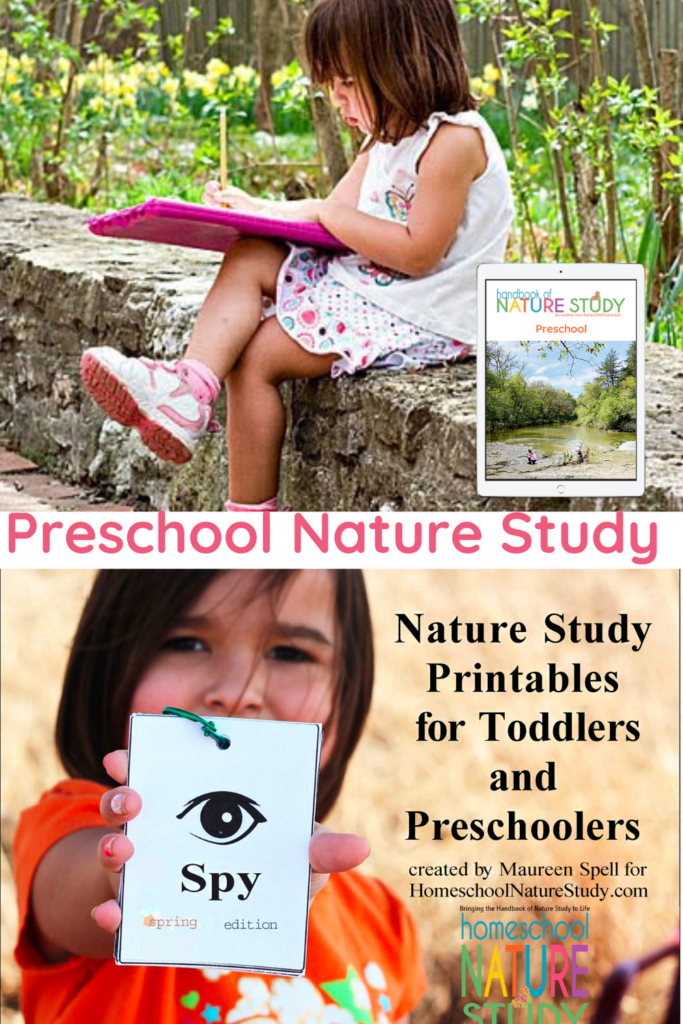
Enjoy these preschool printables alongside our Delightful Preschool Homeschool Nature Study Curriculum!
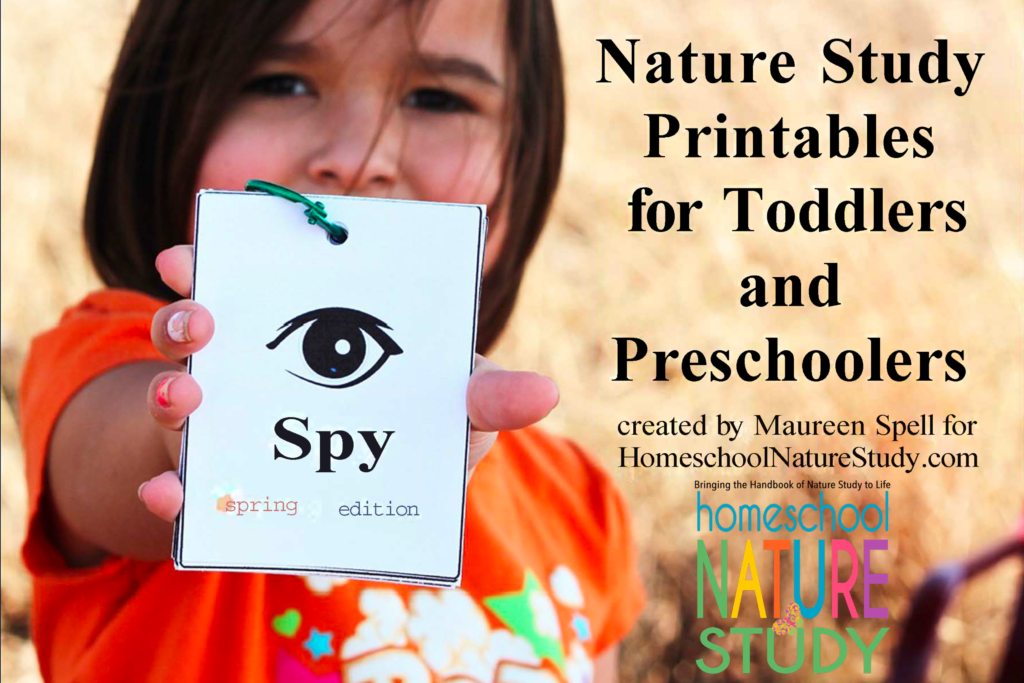
Do you like the idea of involving young children in nature study but not sure how to start? Do you need a little help being intentional with your nature studies? Nature Study Printables is full of printable tools for you to use to get young children observing and talking about nature!
Nature Study Printables For Toddlers And Preschoolers: An Overview
Nature Study Printables for Toddlers and Preschoolers is a 60+ page eBook containing all of our toddler and preschool nature study printables plus 20 exclusive pages available only in this book! Use these tools to help informally introduce young children to the natural world around them.
Table of Contents:
*Debunking Preschool Science Myths *Neighborhood Nature Walks with Young Children *10 Tips for Studying Nature with Toddlers and Preschoolers *Printable I Spy Cards
Animal Edition
Spring Edition
Garden Edition
Fall Edition
Winter Edition
*Printable Nature Booklets
Ants
Butterflies
Fish
Worms
Nature
Frogs
Ladybugs
F.A.Q.’s About Nature Study Printables For Toddlers And Preschoolers
Copypaper and cardstock. Basic supplies such as binoculars and a magnifying glass are fun tools to have on hand but are not necessary. If you don’t have frogs, butterflies, ants, worms, or ladybugs on hand to observe there are kits available for purchase.
How do you make the preschool nature journals?
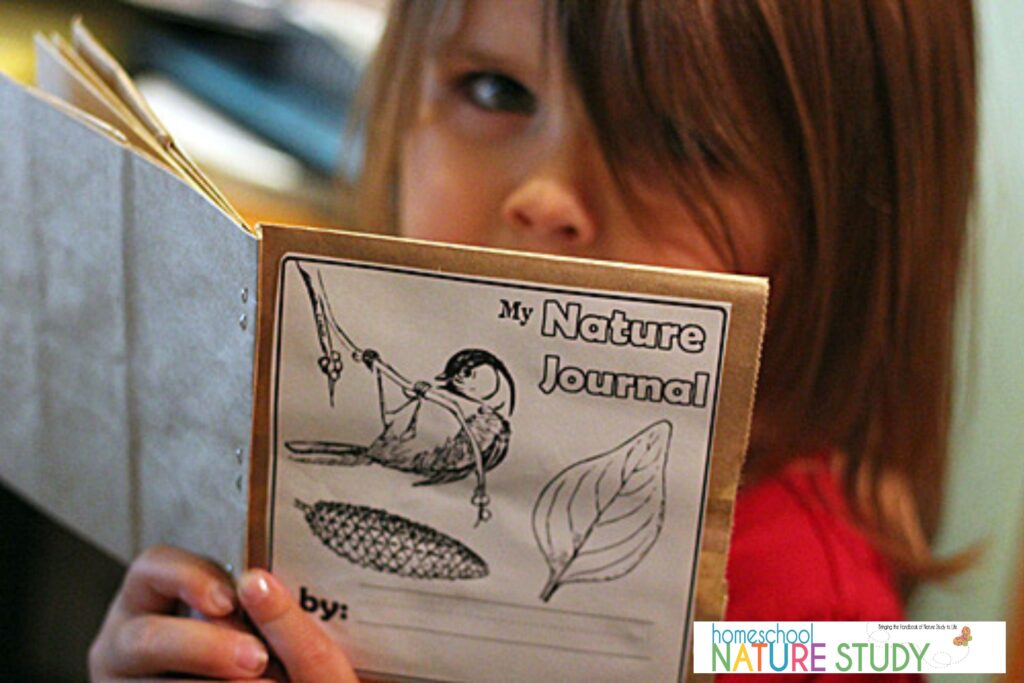
How to make easy preschool science nature journals.
Fun Preschool Learning in Homeschool Nature Study Membership
Enjoy relaxed preschool nature study plans for your homeschool with nature table suggestions, simple nature study activities, field trip ideas, images to print, coloring pages, and so much more. What a privilege to introduce children to the glorious world God created!
Have children eager to be outside? You can think of the earliest years outdoors with your children as the way to grow a love and curiosity about the natural world. This habit develops gradually over their childhood. The earlier you start building a habit of nature study in your family, the easier it will be to encourage children to be engaged in nature study.
By Maureen Spell, a long-time contributor to the Outdoor Hour Challenges.Maureen helps Christian mompreneurs operate their business from a place of joy, purpose, and excellence because they are clear on how their business is serving their family and others. As a homeschool mom, she believes success at home AND business without the mom-guilt, stress and burn-out is possible! Outside of work, she loves having good conversations over a hot chai or GT Gingerberry kombucha and spending time with her husband and seven children. Visit her at MaureenSpell.com
Nature Study Encouragement for Your Outdoor Hour Family Time
Before you begin homeschool garden activities, enjoy these ideas for getting outdoors with your family.
Nature Study in Ripples: Simple Ways to Study Nature
Simple Ways to Study Nature – Here are some simple ways to study nature in your homeschool. Start in your own yard then let your discoveries grow out like ripples in a pond.
“Nature study is, despite all discussions and perversions, a study of nature; it consists of simple, truthful observations that may, like beads on a string, finally be threaded upon the understanding and thus held together as a logical and harmonious whole.”
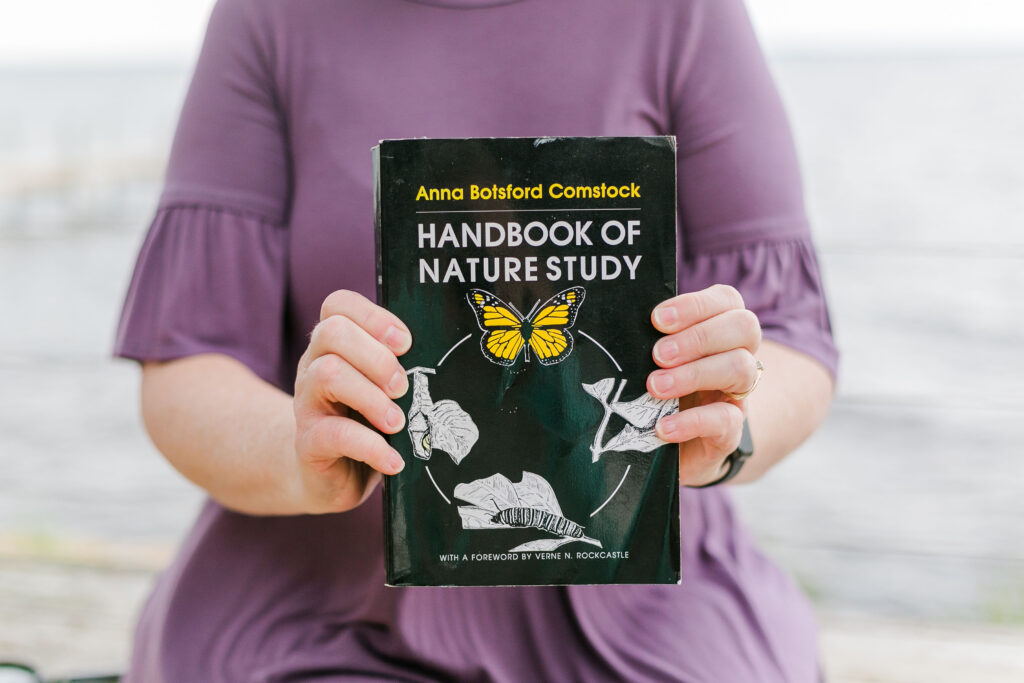
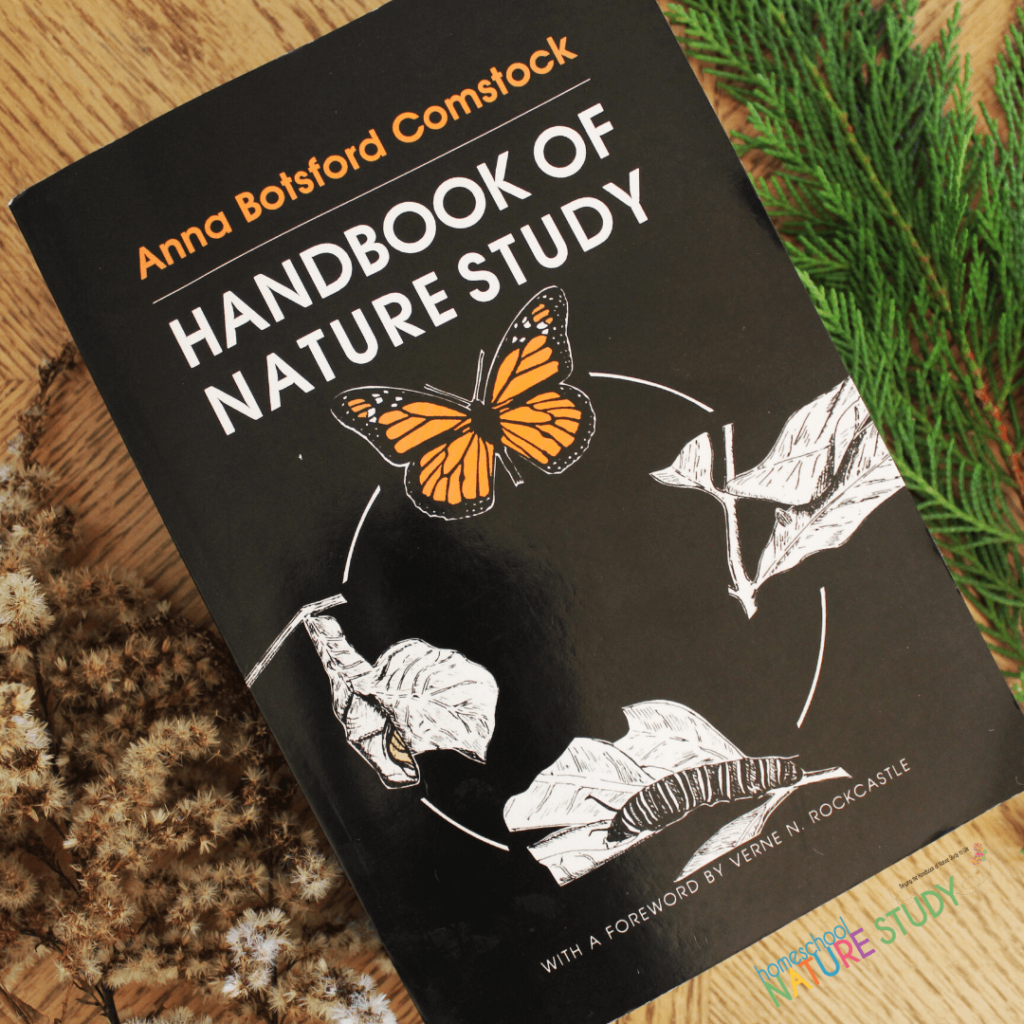
Handbook of Nature Study, page 1
99 Homeschool Nature Study Ideas to Get Your Family Outside
Homeschool Garden Activities Perfect for May Nature Studies
“A child who makes a garden, and then becomes intimate with the plants he cultivates, and comes to understand the interrelation of the various forms of life which he finds in his garden, has progressed far in the fundamental knowledge of nature’s ways as well as in a practical knowledge of agriculture.”
Handbook of Nature Study, page 20 in the section “Gardening and nature Study”
Here are some great nature study ideas for your May homeschool!
Garden and Wildflower Nature Studies with the Outdoor Hour Challenges
You can enjoy a simple garden and wildflowers homeschool nature study with these resources we have gathered for you to use in your own backyard. It is such a delight to study and learn about a garden and the beauty of wildflowers!
Make a Wagon Garden
For this particular garden, I have a rusty old Red Flyer wagon that has wheels that no longer turn…How to Make a Wagon Garden.
World Turtle Day Nature Activities
Turtle Nature Study for Your Homeschool – Learn about pond life, pondweed and a pond habitat with this fun turtle nature study for your homeschool. Includes activities for learning about tortoises and microscopic pond life too.
Mammals: Goat Nature Study
This goat homeschool nature study is packed with fun from fainting goats to advanced mammal studies! Bring the Handbook of Nature Study to Life in your homeschool! Here’s a peek at what you can expect to enjoy in this Outdoor Hour Challenge for Homeschool Nature Study members.
Butterfly Nature Study: How to Make a Butterfly Puddle
Over the years, I’ve observed butterflies along hiking trails in the muddy edges. There will sometimes be 10 or 12 butterflies sitting on the mud slowly opening and closing their wings. This behavior fascinated me! After a little research on the internet, I discovered that butterflies are attracted to mud puddles for not only the moisture but the minerals and salts that are present in the mud. Learn How to Make a Butterfly Puddle!
Homeschool Garden Activities: The Great Sunflower Project
What is the Great Sunflower Project? This is a citizen science activity that you can participate in with your children. If you can grow a sunflower (or selected other flowers), you can join the project with just a few minutes invested later this summer.
Beautiful Queen Anne’s Lace Wildflower Nature Study
Our family made great memories together one year while noticing and studying Queen Anne’s lace throughout the seasons. Enjoy this beautiful Queen Anne’s lace nature study for your homeschool and see what you notice in each season too!
Charlotte Mason Nature Study: Simple Ideas for Wildflowers
These timeless Charlotte Mason nature study ideas are as relevant today as when they were written and I’m forever grateful for the encouragement these gave me when I was a new homeschooler.
Gathering Things for Your Nature Table
Unsure of what a nature table is exactly? Here is a simple definition with some ideas and tips. These will help you begin the habit of gathering things for your homeschool nature table during your Outdoor Hour Challenge time.
Plan a Picnic
You can plan a simple outdoor picnic with the benefit of homeschool nature study! Even a snack in your backyard will make for a fun time together outdoors. You will be surprised at all you notice while you are outside.
The Ultimate Guide to National Parks Nature Study
Ready to enjoy a trip to a national park? Use this guide to national parks nature study for your homeschool and enjoy nature study learning while you explore the great outdoors!
More Homeschool Garden Learning
Gardening in Your Homeschool – As the plant world comes alive again in springtime, what better way to teach our children about nature, food, hands-on history, and practical skills than by gardening? Whether we do a formal study or make gardening a purely hands-on project, our children will learn with a homeschool garden.
Get Them Gardening! Fun Garden Books for Kids – As spring starts to roll in, we turn our thoughts to finally getting outside and enjoying the nice weather. Along with this comes budding trees and growing plants, and gardening both for food and flowers. This collection of garden books for kids will help you include gardening in your homeschool.
12 Delightful Farm Activities for Kids – These 12 delightful farm art activities for kids include fluffy baby chicks, a tractor, a barn, ducklings, a lamb, a cow, a piglet and even the chicken life cycle. Such fun learning for your homeschool!
More Nature Study Ideas for Your May Homeschool
Out of School and Into Nature: The Anna Comstock Story – Out of School and Into Nature: The Anna Comstock Story is a beautiful picture book biography about the author of The Handbook of Nature Study. Anna Botsford Comstock was passionate about children getting out of the classroom and into nature to learn first hand about our beautiful world.
3 Tips for Nature Journaling When You Think You Can’t Sketch – Here is some encouragement for you with 3 tips for nature journaling when you think you can’t sketch. My personal nature journal is a source of great joy and it gives me such pleasure to create pages that record my observations and memories of a particular day, excursion, or season.
How Nature Study Enriches Your High School Biology in Your Homeschool – Just how to include homeschool nature study as part of high school biology? Here you will find a break down of nature study suggestions and accompanying resources for each module of your homeschool biology lessons. I really think it depends on the family and how much nature study you have time to fit in with your high school age children.
Flower and Gardening Activities and Notebook Pages
Learning leaf parts
Poppies and buttercups
Ferns
Looking for pollen
Pressing flowers
How to draw flowers
Learning flower parts and dissection of flowers
The garden snail
Garden Seed Ideas
Coronation Crown Nature Craft for Annual Homeschool Nature Study Members
Victoria Vels shares, “May’s nature craft has landed for our lovely members and we’re feeling rather patriotic with these stunning Nature Coronation Crowns, just in time for the crowning of King Charles II.”
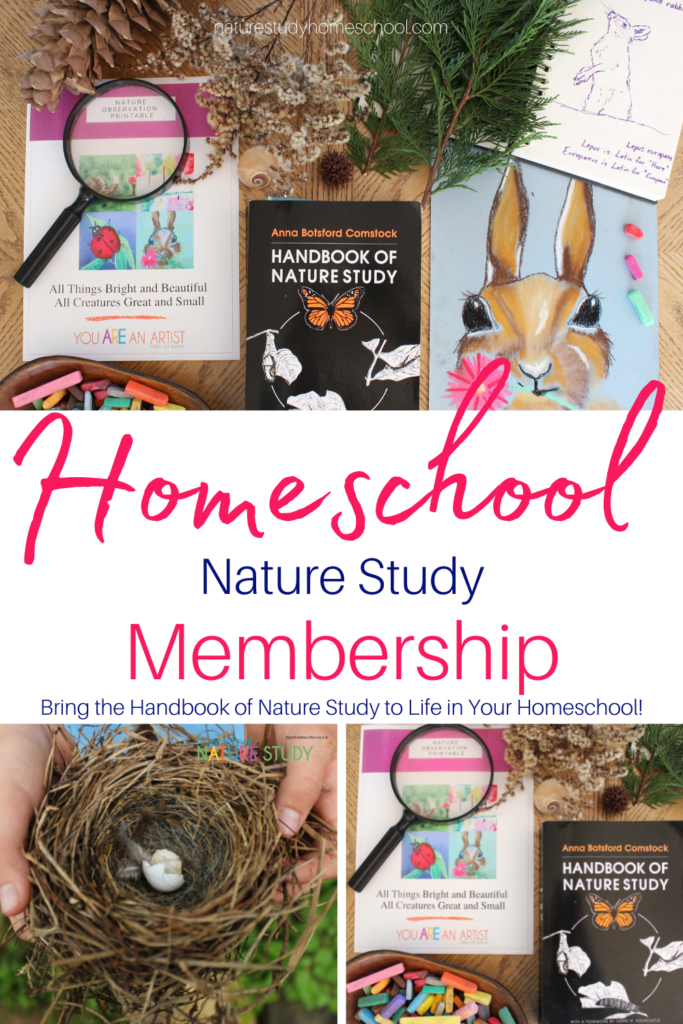
You will find hundreds of homeschool nature studies plus all the Outdoor Hour Challenges in our Homeschool Nature Study membership. There are 25+ continuing courses with matching Outdoor Hour curriculum that will bring the Handbook of Nature Study to life in your homeschool! In addition, there is an interactive monthly calendar with daily nature study prompt – all at your fingertips!
Outdoor Mom Encouragement for Annual Homeschool Nature Study Members
The Outdoor Mom in May Helps Us Refocus
Make it your ambition to lead a quiet life, to attend your own business and work with your hands –
1 Thessalonians 4:11
It reminds me to re-focus my goals and ambitions so that they align with God’s will rather than my own, often more worldly, ambitions.
This verse grounds me. When I put this verse into action in practical ways in my everyday life I find that life slows down and I have enough head space to allow my thoughts to centre on what is important.
The May Outdoor Mom includes:
Choosing a journaling spot
10 (!) May nature prompts for outdoors, for journaling and for either the seashore or mountains
Ideas for working with your hands
Six ideas for making the ordinary extraordinary – including planting a kitchen garden!
Here are some tips for creating a nature journal supply kit for your homeschool. It is simple, inexpensive and is easy to do!
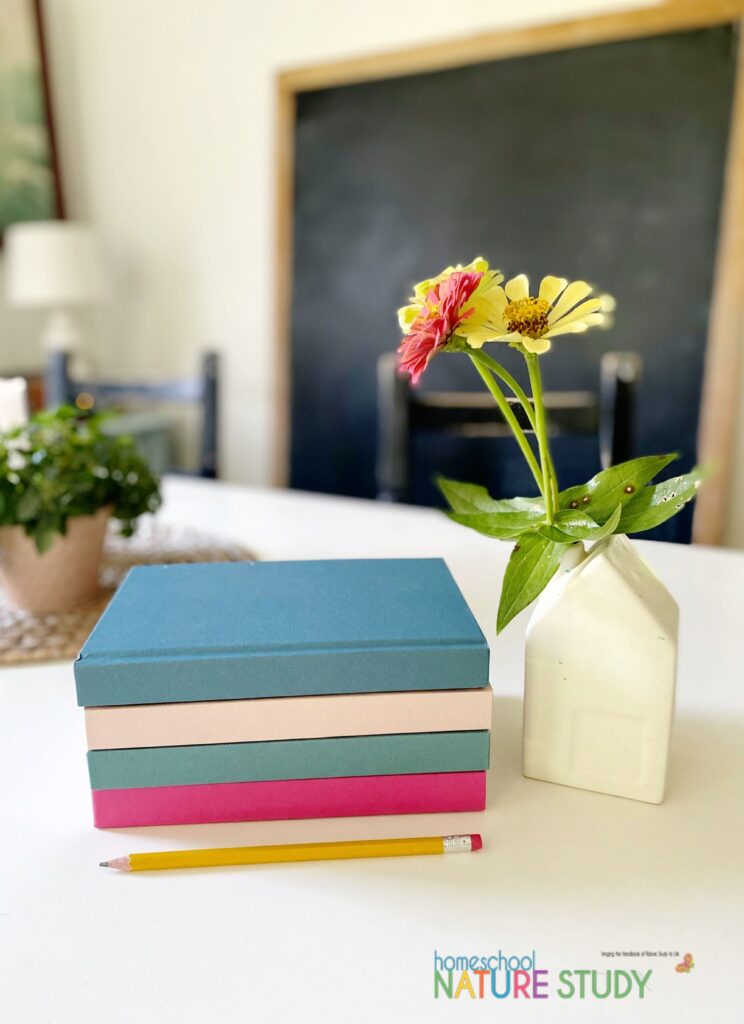
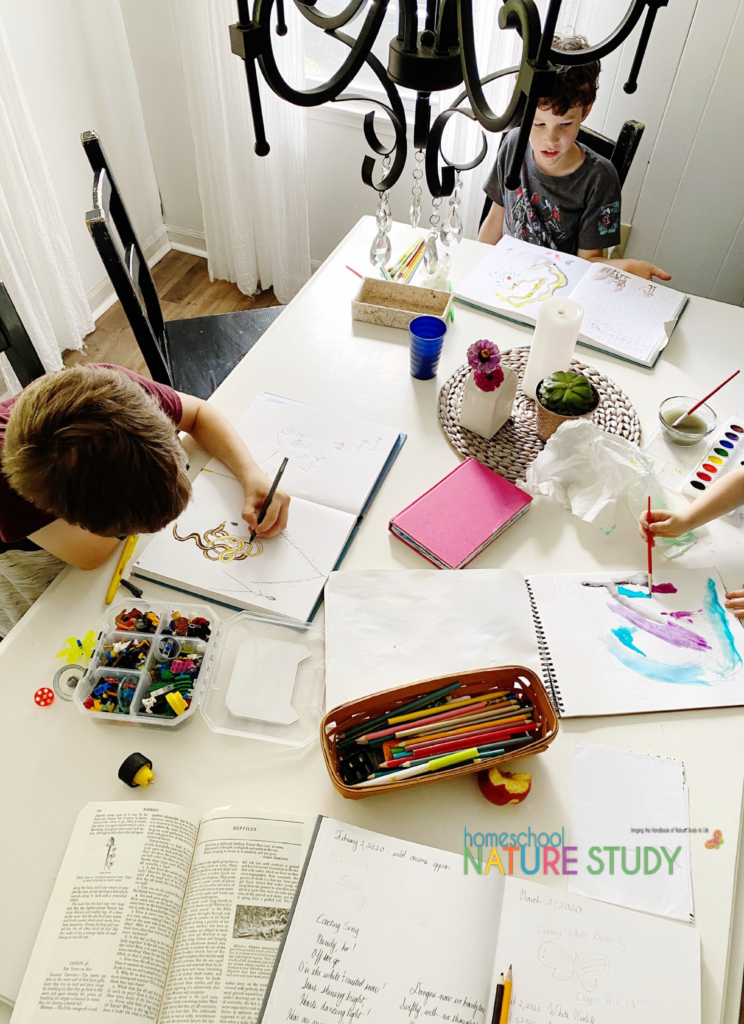
Creating a nature journal with your children is an experience you all can enjoy. I always told my children (and myself) that there’s really no right or wrong way to create a page, except if you never gave it a try. Over the years, I had to create a routine for nature journaling or we would procrastinate or forget it altogether.
One way to give us a better chance of creating a nature journal was to take our journal and our supplies along on our nature walk so we could create a page right at the moment. But, this meant I needed to be a little prepared before we left the house.
So, we created a nature journal supply kit.
Creating a Nature Journal Supply Kit for Your Homeschool
What did we take along with us?
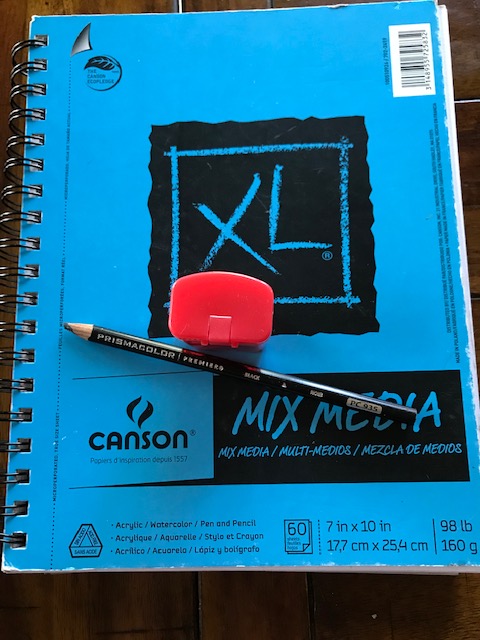
When the children were younger they exclusively used spiral bound journals because they were easier to take along with us when we did our sketching. We used No. 2 pencils and colored pencils pretty much for all the entries.
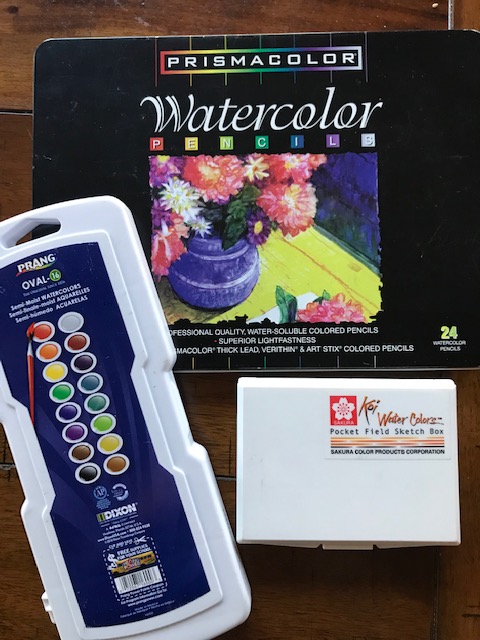
For variety and as they grew older, we started to use colored pencils and thin markers to create our nature entries. Watercolors often gave a wonderful result but they required a bit more effort because you needed to bring along a water source, the brushes, and a paper towel or cloth in addition to the journal.
I found that keeping our supplies all together in one spot and storing them in an easy to find place, made it more likely that we would actually complete a page while we were taking our Outdoor Hour.
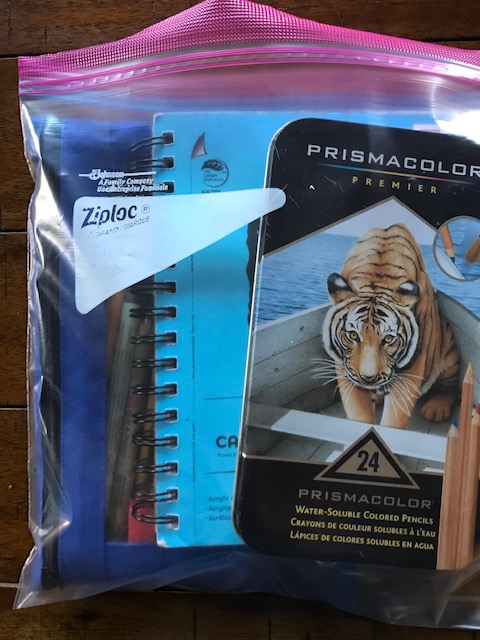
I suggest you find a container like a plastic crate, a tote bag, or a backpack to use as a storage container for your journal supplies. It doesn’t need to be anything fancy. Don’t use anything too large or too heavy or you won’t want to lug it around on your nature walks.
I have a plastic container that I purchased at the Dollar Tree store many years ago that has held up nicely, but I’m sure you have something sitting around your house that you could start off using for now.
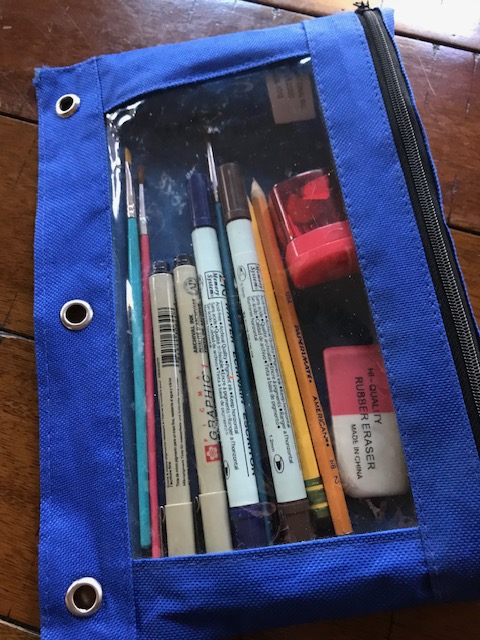
Gather your supplies and remember to keep it simple. A few No. 2 pencils with erasers, a small set of colored pencils, a small set of watercolors and a brush, some tape, a pair of scissors, a water container, and a pencil sharpener can form the foundation of your supply kit.
Over time, your family will find favorite supplies to have when journaling on the road. The most important part of journaling is to have experiences to document on the journal pages. Start there. Create the opportunity for a good nature study and then follow up with a little time to work in your nature journal.
“It was time for new nature notebooks for sure. We purchased these smaller versions of our old notebooks at a Michael’s, and I think they’ll be just perfect. We’ve tried them out, and we are finding the smaller size to be super convenient. I love all the fun colors!” – Amy Law
The habit of nature journaling is something that will benefit your child long after they have grown up. It teaches important observation and documenting skills that will benefit other areas of study and real life.
More Nature Journal Encouragement For The Entire Family
Here are some more ideas and encouragement on nature journaling for you and your children:
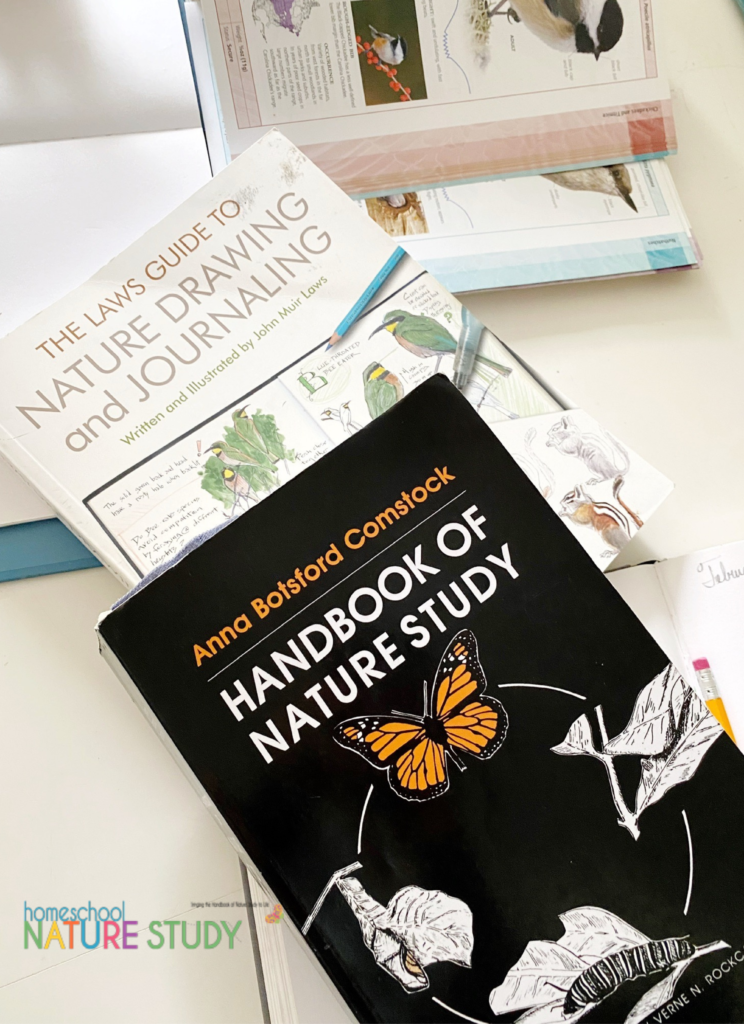
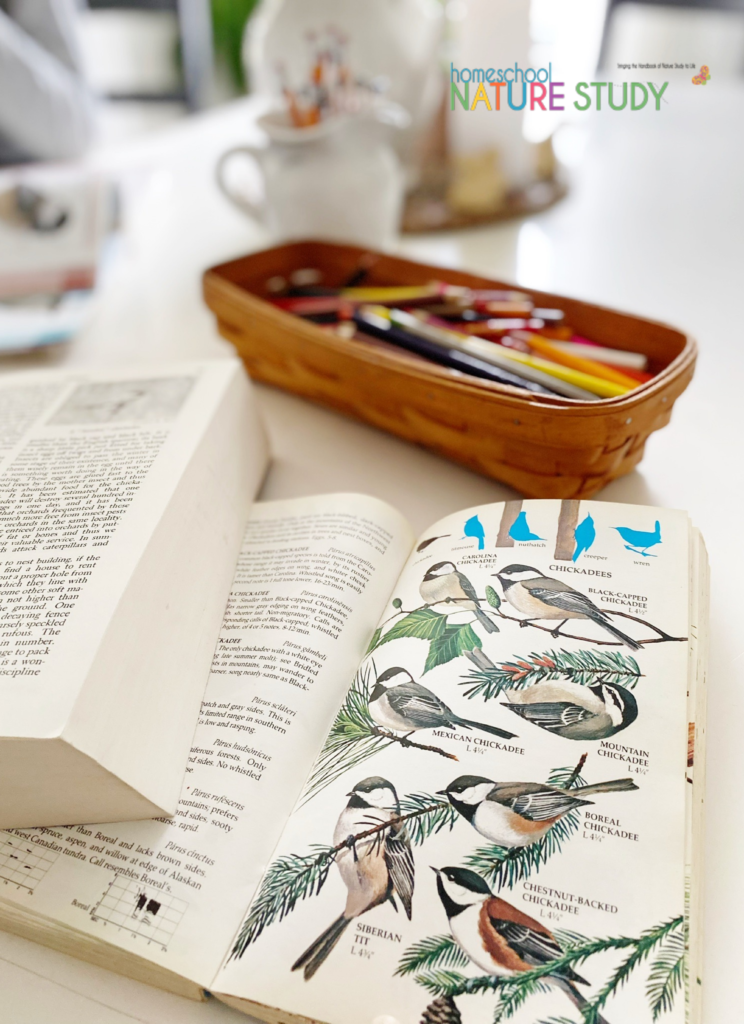
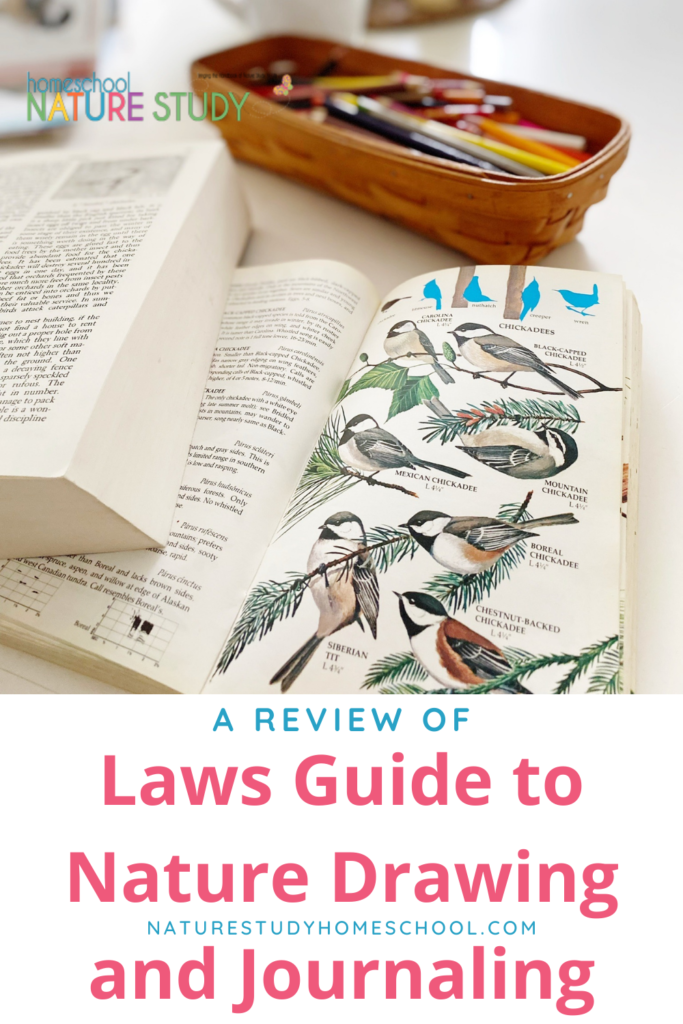
I have seen many books on nature journaling but the Laws Guide to Nature Drawing and Journaling is definitely the most thorough and potentially helpful of any book I’ve ever foundfor our homeschool. <<<<< This book is going to help me in my journaling and drawing skills immensely.
This review includes Amazon.com affiliate links.Please see our disclosure policy.
The Laws Guide to Nature Drawing and Journaling – Review
I finally received The Laws Guide to Nature Drawing and Journaling by John Muir Laws from our public library and it has taken a few weeks to get through an initial read through of this detailed and thorough book. My first reaction was one of happy surprise.
I would have been happy with this book just being a helpful “how to” sort of book with suggestions and hints for getting started with drawing in my nature journal. It was much more than I expected! The sections at the beginning of the book were a delight as they unfolded many ideas and insightful help in the philosophy and methodology behind nature journaling. Laws reminds us that careful and thoughtful observations should be the backbone of our nature study.
“Copying the journaling approaches of others will not reduce your own creativity or make you a clone of another person. You will incorporate what you find useful into your own style and discard what does not work for you.” John Muir Laws (page 63)
The Laws Guide to Nature Drawing and Journaling is full of inspiring illustrations that are not just in the book to be pretty. He breaks his example pages down to show how we can use the ideas and patterns in our own journals.
There are many, many specific drawing tutorials for everyday subjects you may encounter in your nature travels like frogs, flowers, trees, birds, and so much more. This section of the book could be the basis for a complete course in nature journaling. If my children were still homeschooling, my brain would be organizing the material so we could work through it methodically.
“Before you pick up your journal again, reform your intentions; let go of the goal of making a pretty picture. You don’t have to be good at drawing to discover amazing things through the process of journaling. John Muir Laws (page 86)
One of my favorite sections in this book is the two page spread that is titled, “A Road Map from Wishes to Practice”. On these two pages, John Muir Laws puts into words so much of what I try to encourage my blog readers to remember about journaling – everyone can draw with practice!
Take Your Nature Journaling Skills to the Next Level
If you are new to drawing or feel you don’t have a gift for drawing, this book is going to be a perfect bridge for you to get from where you are to the next level. It has specific step by step tutorials that will give you the confidence to start a practice of journaling. The author gives us all encouragement that we can take our skills to the next level with lots of practice and we will only fail if we give up or don’t try!
I highly recommend The Laws Guide to Nature Drawing and Journaling. I am going to be purchasing it to help me in my nature goal for 2017 to create a nature journal page each week. It will be a very beloved and well used book that I will keep in my personal nature reference library. I may be purchasing a few as gifts to share with some young friends I know that love nature and drawing.
The Laws Guide To Nature Drawing And Journaling: An Overview
If you read this book, don’t miss the first 17 pages. There are some fundamental ideas found there that I truly think will shape my thinking about science and nature study for a long time to come. He has gathered some important ideas on these pages and I would hate to think you are going to skip them to get to the drawing tutorials.
He suggests using the prompts I notice, I wonder, and It reminds me of to help us go a little deeper in our nature journaling.
There are project ideas that help you get started as you face a blank page. Check out pages 20 and 21.
Although this book is written by someone who lives on the west coast of the United States, the ideas and tutorials are applicable to anyone no matter where you live.
There is a comprehensive supplies list with specific suggestions that I found extremely helpful. I am a firm believer that having quality materials and a variety of media to choose from makes all the difference in your results.
Not only does he have a list of supplies, he has pages dedicated to showing you exactly how to use the pencils, pens, colored pencils, gouche, watercolors, and watercolor pencils in your nature journal, including some common mistakes beginners make using the materials. Helpful!
If you have never checked out the author’s website, you NEED to: John Muir Laws.
Look for this book at your public library or put it on your Amazon wishlist!
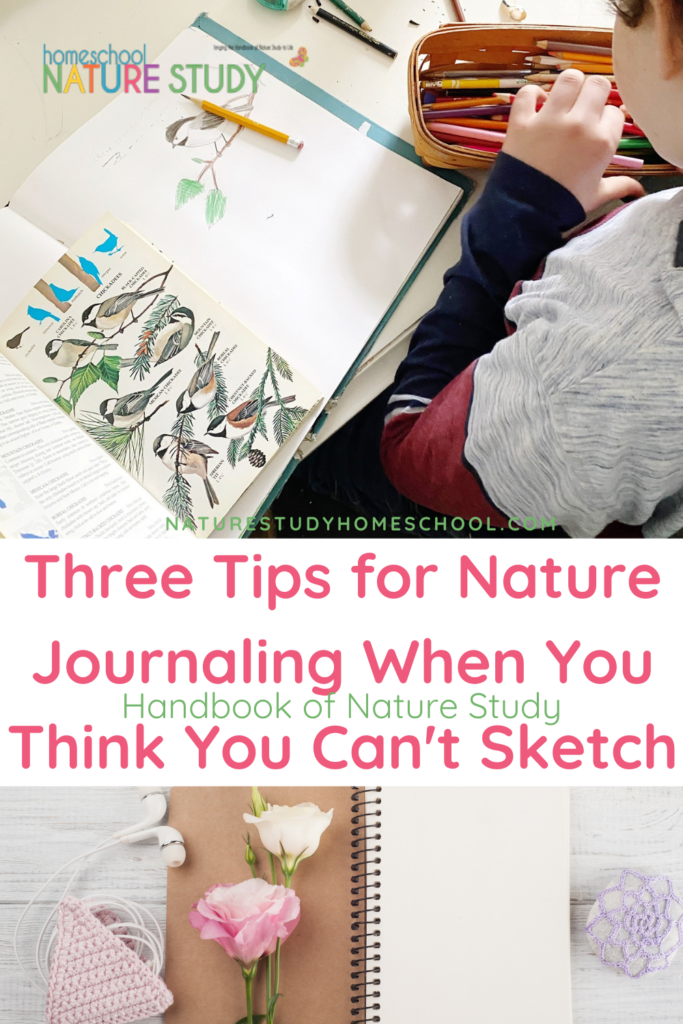
Here is some encouragement for you with 3 tips for nature journaling when you think you can’t sketch. My personal nature journal is a source of great joy and it gives me such pleasure to create pages that record my observations and memories of a particular day, excursion, or season.
This post is directed to moms who think that they can’t start a nature journal because of a lack of drawing skills.
Nature Journals For The Mom Who Doesn’t Sketch
I do very little actual sketching in my nature journal but have learned to use a variety of techniques to keep each page fresh and in touch with my personal style.
So what should you remember if you think you can’t sketch and you want to start a nature journal?
3 Tips for Nature Journaling When You Think You Can’t Sketch
1. Keep it simple and don’t be afraid to get started in nature journaling.
A blank page can intimidate even the most seasoned journal-keeper. Work through your fear of failure by starting small and keeping it simple. Be a good role model. If you have children and you are encouraging them to keep a nature journal, you can empathize with their feelings of inadequacy. Be brave and your children will look to your example and be more confident about their own journals.
2. Use a variety of ideas…find something that works for you.
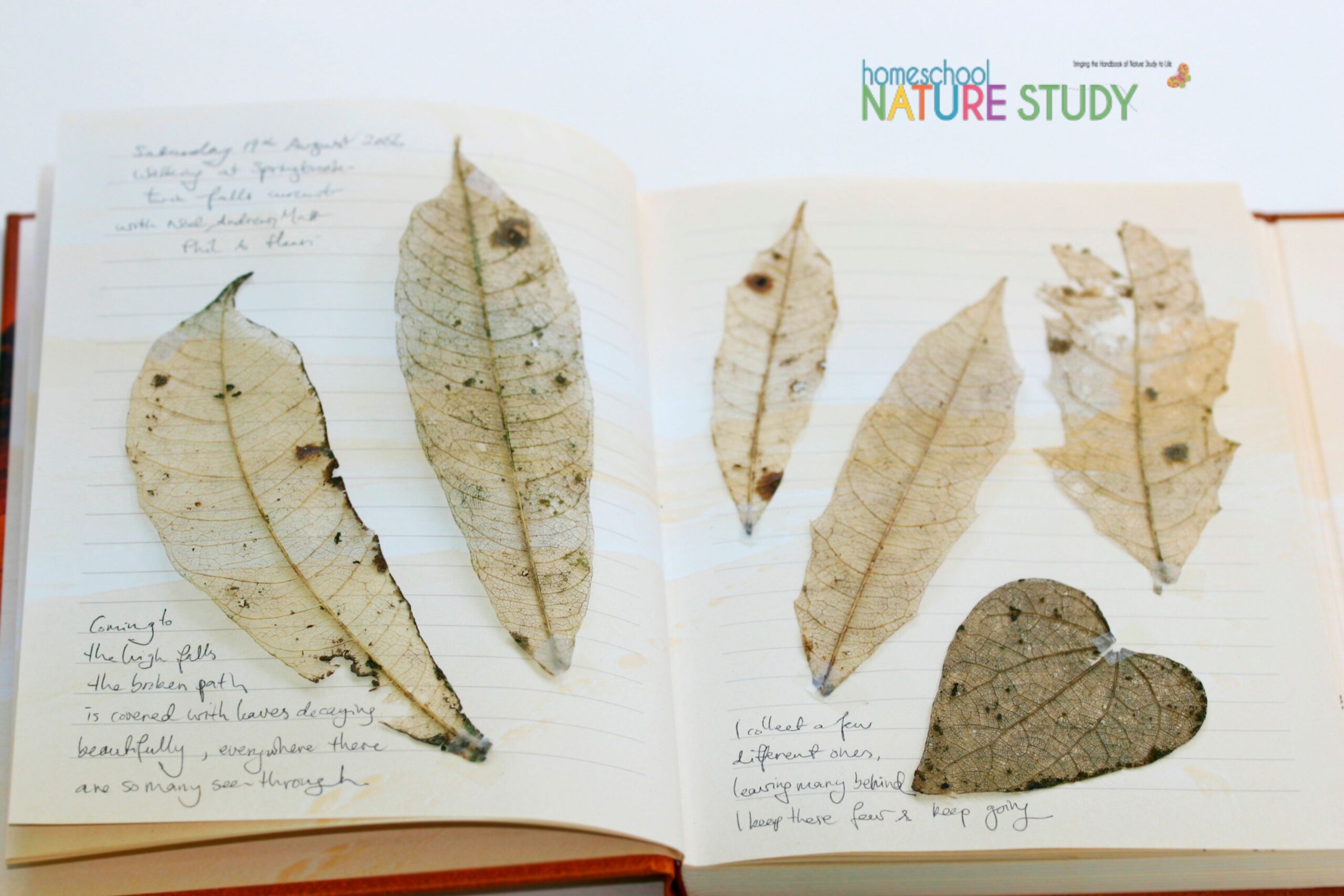
You are not required to sketch. Try something else. Keep a list, include an photo, copy a poem or some facts…just get started. Don’t wait. You may someday feel like sketching or watercoloring in your journal but it is not a requirement. There are no rules for nature journals. Use color and a few well placed decorations to make your journal more personalized if you feel inclined.
3. A nature journal can be a private place of joy.
Keep in mind the purpose of a nature journal and remind yourself that it is a personal keepsake and record of your thoughts and experiences. You do not need to share it with anyone…in real life or on the internet. If it makes you happy that is all that counts.
Taking it one page at a time, you will build a treasured spot for your nature study and outdoor memories.
More Nature Journal Encouragement For The Entire Family
Here are some more ideas and encouragement on nature journaling for you and your children:
Taking the time to draw leaves helps you observe the details. For young children, a wonderful starting place for a homeschool leaf nature study is to make leaf rubbings.
When my children were young, autumn walks always included collecting colorful leaves. We might get home with handfuls of leaves in a rainbow of autumn shades. We would talk about the shapes and what tree each leaf came from or which ones were our favorites. Once home, we’d pull out crayons or markers and attempt to draw a few of the leaves on paper to be hung on the refrigerator or given as gifts to grandparents. Nature study was casual and enjoyable.
As they grew older and we would be out during our homeschool day, I would sometimes follow up with a more detailed nature study lesson using the Handbook of Nature Study or our tree field guide. The amount of information we would cover really depended on the children’s interest and my aim. By high school we were more deliberate in our autumn leaf studies using more scientific vocabulary and I expected them to create a more detailed nature journal as part of our more formal science lessons.
Learning about trees, leaves, autumn, and the neighborhood can build over many years and still seem to be just a part of learning about the world we live in and the trees that share the same space.
I love this quote from Anna Botsford Comstock:
“During autumn the attention of the children should be attracted to the leaves by their gorgeous colors. It is well to use this interest to cultivate their knowledge of the forms of leaves of trees; but the teaching of the tree species to the young child should be done quite incidentally and guardedly. If the teacher says to the child bringing a leaf, ‘This is a white-oak leaf,’ the child will soon quite unconsciously learn that leaf by name. Thus, tree study may be begun in the kindergarten or the primary grades.” Anna Botsford-Comstock
Leaf Homeschool Nature Study: How to Make Leaf Rubbings
I have many resources here on my website that will help your family learn about leaves, some for younger students and some for older and more advanced students. I’ve found that taking time to draw leaves makes you observe them closely and see the specific features each tree’s leaves involve.
I highly recommend starting with simple sketching and/or rubbing of leaves with younger children.
You can watch my short YouTube video that shares some of my tips for drawing leaves, how to make leaf rubbings, and using a flower press for pressing leaves here: Tips for Drawing Leaves.
You may wish to complete the Outdoor Hour Challenge that features collecting leaves. Click over and read how to complete a simple leaf study: Collecting Leaves.
Making Leaf Prints with Ink: This activity is wonderful for older students to quickly create a leaf nature journal page using ink pads and leaves they collect.
Image of the cover 9/15 NL
Now that autumn is here, I’m trying to embrace its beauty. We don’t have much “fall color” here in my part of the world but the little bit we do have will be appreciated and perhaps even make its way into my nature journal.
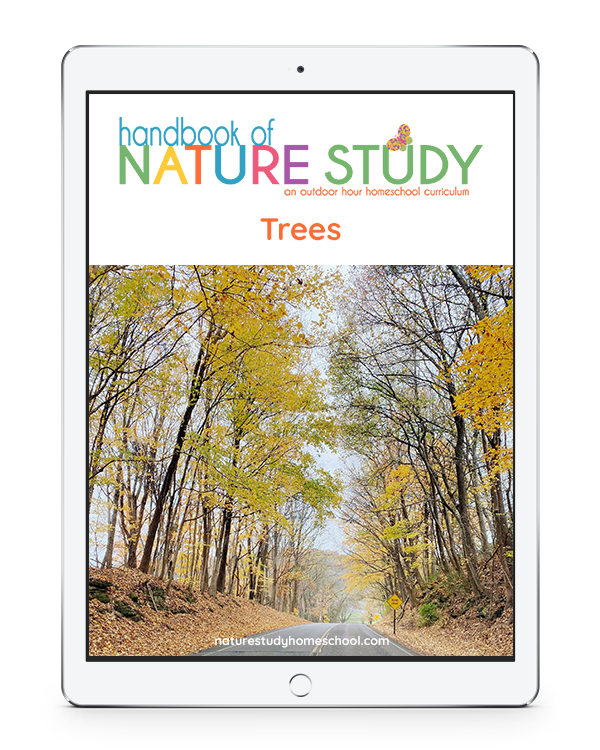
Members can look in the library for many more printable tree and leaf activities and notebook pages in the Trees course.
Join The Homeschool Nature Study Membership for Year Round Support
You will find hundreds of homeschool nature studies plus all the Outdoor Hour Challenges in our Homeschool Nature Study membership. There are 25+ continuing courses with matching Outdoor Hour curriculum that will bring the Handbook of Nature Study to life in your homeschool! In addition, there is an interactive monthly calendar with daily nature study prompt – all at your fingertips!
Just how do you enjoy a Charlotte Mason nature study for your homeschool? Let’s look at some advice from Charlotte Mason herself and apply it in a simple way to our own outdoor times.
“One afternoon a week, the students in our ‘Practicing School’ [taught by the student teachers at Charlotte Mason’s teacher’s college] go for a ‘nature walk’ with their teacher. They notice things by themselves, and the teacher tells them the name or gives other information only if they ask for it.”
“The teachers are careful not to turn these nature walks into an opportunity to give science lessons, because they want the children’s attention to be focused on their own observations.”
“They’re allowed to notice things with very little direction from the teacher. By doing this, children accumulate a good collection of ‘common knowledge.’ ”
-Charlotte Mason
“Even more important, students learn to know and take pleasure in objects from nature like they do in the familiar faces of friends.”
-Charlotte Mason
Nature Study in Your Own Backyard
I have certainly given my share of “science lessons” during our nature walks and nature time. I am getting better about letting the children direct me to what they are curious about. I see the wisdom in allowing them to explore and learn in a way that makes sense to them, but I can be available to assist them with questions they might have. I am pretty comfortable with telling them that I don’t know the answer to their question and then find someone or some resource that does have the answer.
“The nature walk shouldn’t be used as a chance to dispense miscellaneous tidbits of scientific facts.”
-Charlotte Mason
These principles are the same whether your nature study takes place in your backyard, on the trail, or during some other nature study outing. As the parent, you set the mood. If you quietly observe your children, you will see what they are drawn to learn more about without much effort.
Try it the next time you are having your outdoor time.
Charlotte Mason Style Exam Questions for Homeschool High School
Several of the courses included in Homeschool Nature Study membership include Charlotte Mason style exam questions for advanced students. Author Barb McCoy says, “This series has proved to be a huge success in our family, helping to bring nature study up to a level for my teens. Also, I saw families with large age ranges of children completing the challenges together, each on their own level and enjoying it.”
You can feel free to pick and choose which questions you will give your homeschool high school student according to their interest and abilities.
You can successfully continue nature study with your teenagers. They may need some encouragement to make the study their own by adjusting your subjects, your methods of follow-up, and your attitude towards what nature study should look like.
More Resources for Charlotte Mason Nature Study Time
Join The Homeschool Nature Study Membership for Year Round Support
You will find hundreds of Charlotte Mason style homeschool nature studies plus all the Outdoor Hour Challenges in our Homeschool Nature Study membership. There are 25+ continuing courses with matching Outdoor Hour curriculum that will bring the Handbook of Nature Study to life in your homeschool! In addition, there is an interactive monthly calendar with daily nature study prompt – all at your fingertips!
Keeping a nature journal and building the homeschool nature journal habit can be a wonderful extension of your outdoor learning time. You will find nature journal ideas for everyone from young children to the homeschool mom!
The Homeschool Nature Journal Habit
Like all habits, the habit of keeping a nature journal starts by making it a regular part of your routine. I’ve found that families that create a simple nature journal page after their outdoor time are the most successful at keeping that habit over time. Don’t make it too complicated or overthink the process.
Many of us struggle with perfection. We think that a nature journal should be a place of beauty and value…which I agree with wholeheartedly. But, it also can be a place that we experiment and mess up from time to time. A smear here or a misspelled word or funky drawing we don’t like can also appear on a nature journal page. Those “mess ups” shouldn’t keep us from establishing a nature journaling habit.
The Benefit of Nature Journals for Young Children
I can’t emphasize enough that the single most important factor in starting a nature journaling habit in your family is the example you as the parent can set for your children. If you regularly get out your own nature journal and make entries, eventually your children will participate alongside you. Charlotte Mason wrote that if a child is too young to write or create their own journal entry, the mother can be their secretary and help them with the writing portion of a nature journal entry.
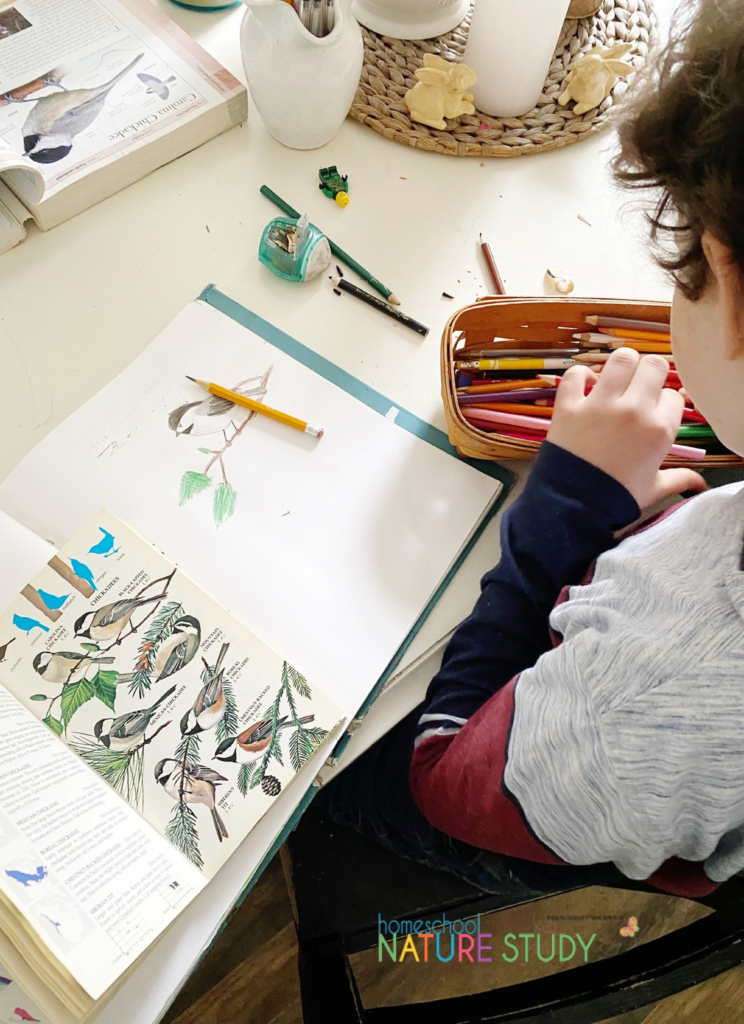
In my experience, many times after a nature walk, my kids were eager to do a sketch of something they observed while outdoors. Those pages may not be elaborate, but they are personal to the child.
See Outdoor Hour Challenge #2 Using Your Words and Outdoor Hour Challenge #3 Now is the Time to Draw for help getting started with simple nature journals with your children. If you’re a Member, you can download the Getting Started ebook for additional information and printable journal pages.
Nature Journal Page by Shirley Ann Vels https://buildingahouseholdoffaith.com/
Nature Journals for Homeschool Moms – Good Habits Start With You
It is my journal, and it can be any way that I wish it to be. When I first started journaling back in approximately 2008, I felt the pressure to make my entries pretty and artistic. The examples I could find online were by real artists and not just a regular mom like myself. I needed to stop comparing myself and just be inspired by these other nature journal pages.
Keeping a nature journal is a long-term life project. My nature journal goes with me on every trip we take….I have packed it three times to Hawaii, to Yellowstone, on countless trips to Yosemite, and on most every little day trip I make. Do I always remember to pull it out and record things? No. Do I wish I would have made more entries? Yes. There is the lesson: Once you build the habit of journaling, you will be more excited about recording all your nature experiences whether they are close to home or far away on an adventure.
If you want your drawing skills to improve, you must practice. That’s a tough one for most of us. I did not come from an artistic background so giving myself permission to try to learn to draw or paint or do anything artistic took a big shove from my husband. It took time and effort. My suggestion for people who are striving to do a better job in sketching is to go to your library and go to the children’s section first and check out “how to draw” books and use them alongside your children. I checked one out on how to draw insects and one on how to draw birds and then found some nature sketching books to try. These experiences with the book open in front of you and your sketching from the step by step instructions will eventually spill over into your nature journal. The added bonus is that you will be modeling for your children the process and the effort to nature journal. There is no magic formula, but your success is equal to the effort you are willing to put into it.
Nature Journal Resources For Your Homeschool
Simple Nature Journal Ideas (on Hubpages): This is a thorough collection of my simple to use nature journal ideas and a resource for my picks for nature journaling supplies.
Nature Journal Examples: This link will take you to a Flickr album with many nature journal pages our family has created.
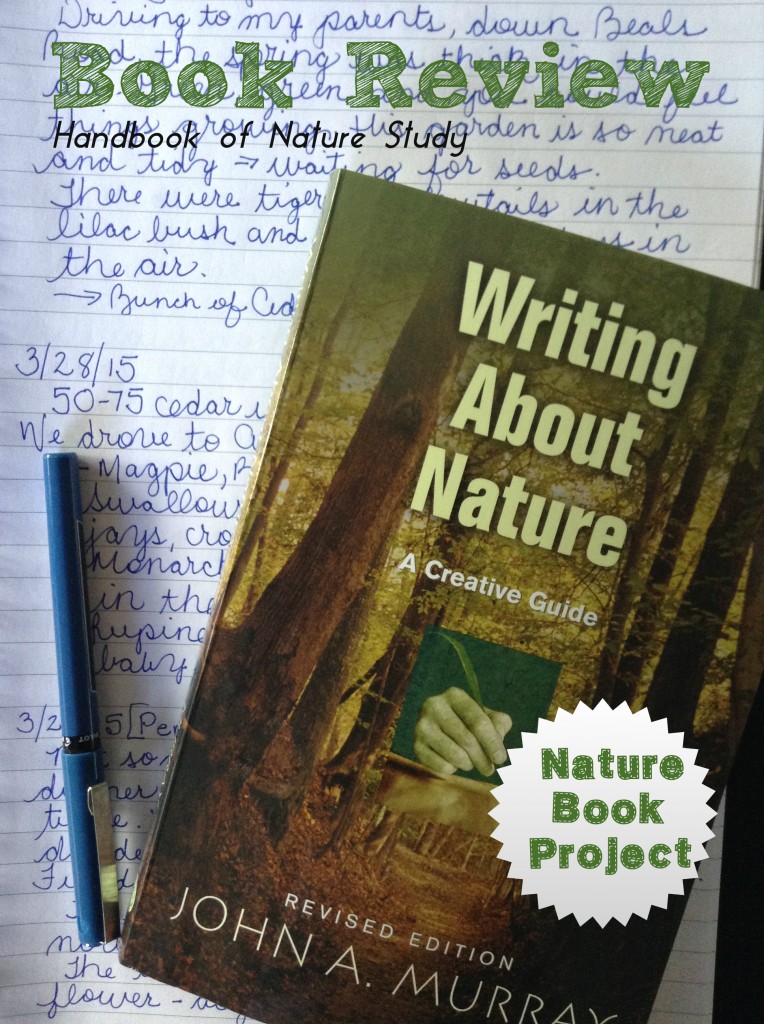
Nature Journaling in the Handbook of Nature Study:
Pages 13-15 (The Field Notebook). In this section Anna Botsford Comstock helps us with a detailed description of her idea of a field notebook or nature journal. She also states that if done properly “they represent what cannot be bought or sold, personal experience in the happy world of out-of-doors”. Make note of any suggestions you want to implement with your children.
Page 17 (The Correlation of Nature Study and Drawing). Highlight the points that will help you with your nature journals. “Too much have we emphasized drawing as an art; it may be an art, if the one who draws is an artist; but if he is not an artist, he still has a right to draw if it pleases him to do so.”
Nature Journal Outdoor Hour Challenges in Homeschool Nature Study Membership
Outdoor Hour Challenge #3 – Now is the Time to Draw: This challenge from the free Getting Started series is a perfect way to begin small with nature journaling.Members can download the ebook and the notebook pages that go along with it to introduce a nature journal to your children.
Outdoor Hour Challenge #2 – Using Your Words: If you’re having trouble coming up with words for your nature journal, this challenge will give you some direction.
You can always use any of the printable notebook pages in the Homeschool Nature Study membership for your nature journal.
If you’re not a member yet, please consider joining to gain the benefit of having a nature study library at your fingertips. There are numerous resources available for you to help create the habit of nature study within your homeschool family.
Here are some great resources you can use as ideas for drawing in your nature journal. Several are links to coloring pages but I like their black line drawings that simplify an object so we can learn to draw them on our own in our journals.
Make sure to check out all the links even if they are from a state or habitat other than one where you currently live. Many times there are animals, plants, and birds that you will have in your location too. I don’t necessarily print the coloring book pages out and color them. We will use them as a guide to draw our own sketches of things we see in our Outdoor Hour Challenge or for our nature journal.
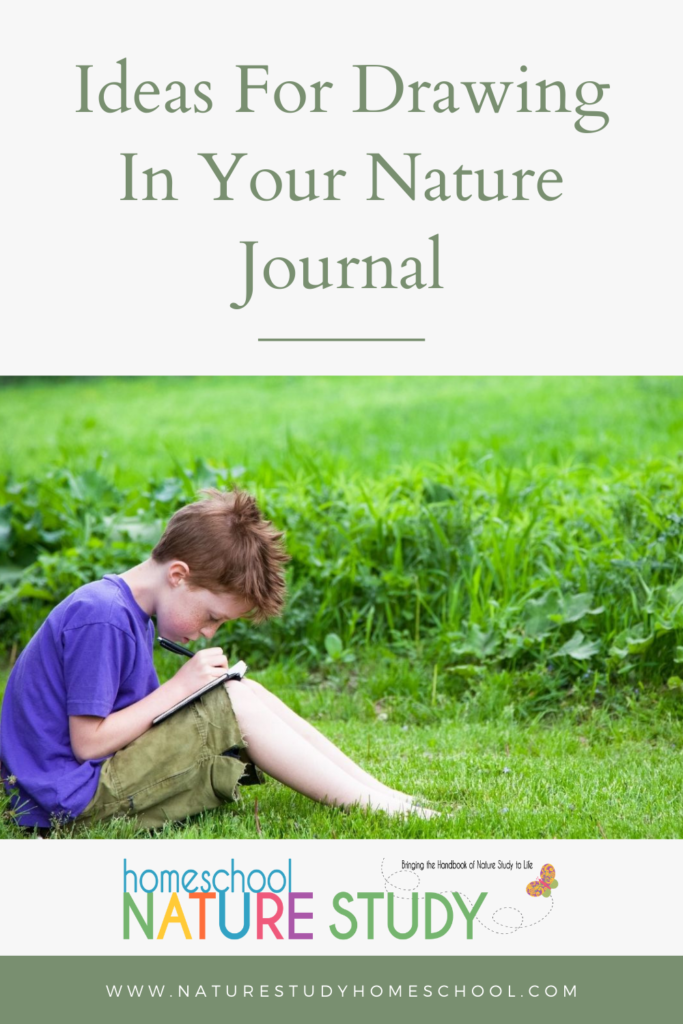
Ideas For Drawing in Your Nature Journal
Drawing Wildflowers in Your Nature Journal
Celebrating Wildflowers from the US Forest Service These coloring pages are in PDF format so once you bring up the page, you can print out just the page you want and there is no need to print every page out on your printer.
Birds Homeschool Nature Study
Feeder Birds Coloring Book from Cornell These are not only coloring pages but could actually be used as notebooking pages for your nature journal. I print out the table of contents to keep in my notebook as a reference. This way I know what birds are included in the coloring book.
Various animals, birds, and reptiles: Wildlife of New Mexico – This coloring book is worth a look. I think it is especially well done and many of the animals are found in other states as well. PDF format.
Join Our Homeschool Nature Study Membership for Year Round Support
You will find a continuing series on nature journaling plus all the Outdoor Hour Challenges for nature study in our Homeschool Nature Study membership. Plus 25+ continuing courses with matching curriculum that will bring the Handbook of Nature Study to life in your homeschool! In addition, there is an interactive monthly calendar with daily nature study prompt – all at your fingertips!
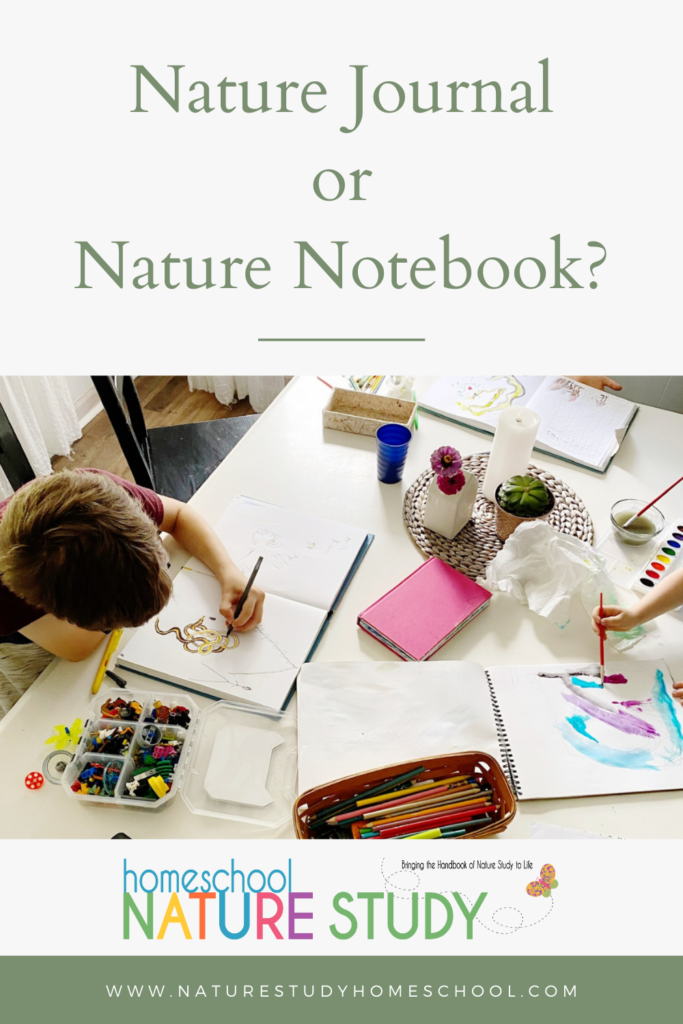
Should you have a homeschool nature journal or a nature notebook? What is the difference between the two?
I always remind new homeschool nature study families that the journal page is the icing on the cake.The most important part of nature study is the time spent outdoors together with your children. You are successful whether you end up with a page in your journal each week or not.
I had a really good question from Joy and I thought maybe you might like to hear my response.
Here is Joy’s question: First off, I have read all of Charlotte Mason’s Original Homeschooling Series as well as Karen Andreola’s Charlotte Mason Companion, along with various others (and I’ve read all that you have on your site concerning Nature Journaling). But, I am still left wondering, is there a difference between a nature journal and a nature notebook?
For example, the notebooking pages that are offered along with the GH challenges (that Tina made) would go into a nature notebook. However, I really like the nature journal idea, with the dry brush method, etc. and it would seem that this would be a different thing all together.
The nature journal would seem to be a sketch book whereas the notebook would be something that would go into a 3 ring binder. So, how do these mesh together, and should I have my children do both? I know these questions are possibly silly to those who have done this for a while, but since I am just starting out, I don’t want to overwhelm my little ones (2nd grade and 1st grade). I really just want a streamlined way to encourage them to interact with what they are learning outdoors.
The Answer To Nature Journal or Nature Notebook:
First off I think this is a really good question and if you ask ten different people, you will get ten different answers. But I will take a stab at it since it relates to the Outdoor Hour Challenges. Clarifying things is always a good opportunity to fine tune our ideas.
I did a little research on what a “nature journal” is and the best explanation of it I found was in Clare Walker Leslie’s book, Keeping a Nature Journal. She explains it this way.
“Simply put, nature journaling is the regular recording of observations, perceptions, and feelings about the natural world around you. That is the essence of the process. The recording can be done in a wide variety of ways, depending on the individual journalist’s interests, background, and training. Some people prefer to record in written prose or poetry, some do it through drawing or painting, others with photographs or tape recordings, and still others through musical notation…..Many people use a combination of these techniques.”
In the Handbook of Nature Study, Anna Comstock calls the nature journal a “field journal” but it is still the same thing, a nature journal. In Charlotte Mason’s original homeschooling series in volume one, she refers to the nature journal as a nature diary. The idea is all the same idea, to record personal observations and thoughts about the world around you.
So Joy, to answer your question with the short answer, either method is still considered nature journaling whether you use a spiral bound sketch pad with watercolors, markers, or pencils or if you choose to use sheets of paper slipped into a 3-ring binder when you are finished. In our family, we do combinations of both recording in the nature journal and on paper.
Notebooking Pages May Be Easier For Younger Writers
Your children are still very young so you may wish to have them work on individual sheets of paper and slip them into sheet protectors when they are finished and store them in a binder. You may at a later date start them in their own spiral bound nature journal. Either way you can include many different types of mediums.
You can still watercolor and slip them into the binder. You can press flowers and slip those in too. If you come across a nature notebooking page you like you can fill those out and put those in the binder. The notebooking pages are nice for younger children because most of them include lines to write your notes on – which is easier for younger writers. I have one son that likes the notebooking pages because he hates a blank page. If it is in a notebooking page format, he can easily think of things to fill it up.
I hope that clears things up a bit. I know there are a lot of choices and you will eventually come to the answer for your family about which one works the best. Nothing is set in stone either. You can start one way and change at any time. It depends a lot on how you are going to use the nature journals and how your children feel about recording in them. When my boys were little, we filled up lots of pages each year so they loved starting fresh each fall. Now we perhaps make an entry a week and we have slowed down considerably in the volume of notebooks.
Make nature journaling a pleasant experience. I know that many times for myself I end up not liking a page until it is all done. It has taken me many years to develop my own style of nature notebook. Want a glimpse into my nature journal? How to Get Started Nature Journaling
I have come to the conclusion that the line between nature study and a nature journal is getting sort of fuzzy. You can have lots of nature study and not have a nature journal.
Don’t let your lack of skill in drawing keep you from your nature study
Nature walk = Time outdoors + time spent in observation
Nature study = Time outdoors + time spent in observation + time learning about your discoveries
Nature journal = Time outdoors + time spent in observation + time learning about your discoveries + time recording your observations and thoughts
I am in no way discouraging nature journals but I am convinced that if you spend enough time in nature study, you will have more to write about in your journal.
Join Our Homeschool Nature Study Membership for Year Round Support
You will find a continuing series on nature journaling in our Homeschool Nature Study membership. Plus 25+ continuing courses with matching curriculum that will bring the Handbook of Nature Study to life in your homeschool! In addition, there is an interactive monthly calendar with daily nature study prompt – all at your fingertips!